


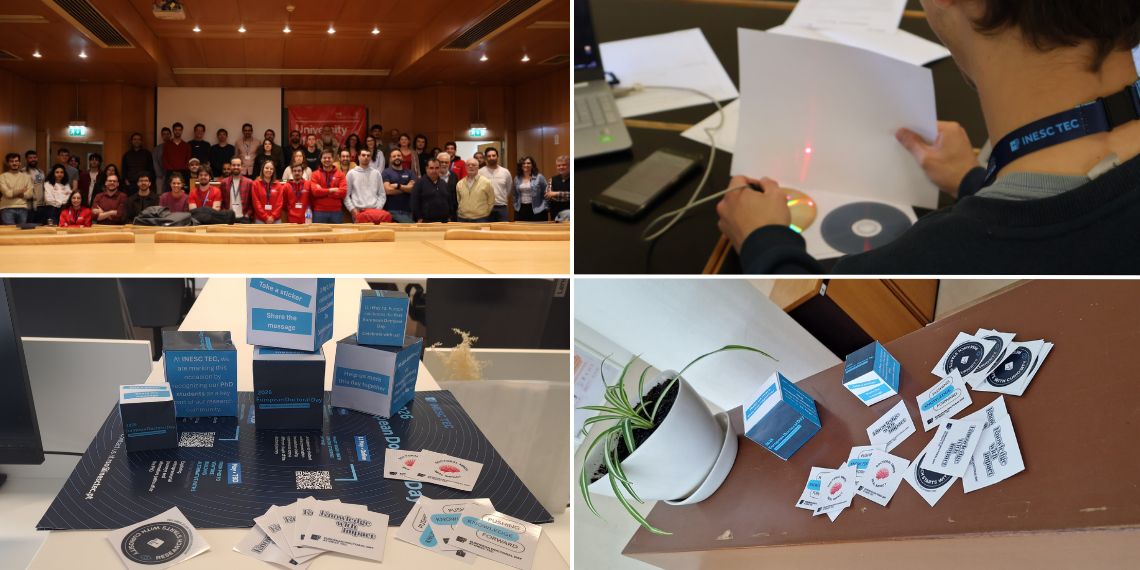
The activities included a session entitled What I Wish I Knew Before Starting My PhD and the celebration of the International Day of Light, in collaboration with the SPIE Chapter of the University of Porto and INESC TEC.
It was the first time – but certainly not the last – that the European Doctoral Day was observed as a joint international initiative, recognising the importance of this level of research and the contributions to science, innovation and society. INESC TEC was one of the institutions that joined the celebrations, with a series of initiatives aimed at recognising the doctoral community, career paths, contributions, challenges and impact.
Among the activities promoted (designed with a complementary approach to address the different dimensions of the PhD experience) one highlight was the sharing, through the Health and Wellbeing newsletter sent out by INESC TEC’s Human Resources service, of “content dedicated to wellbeing, with strategies for dealing with stress and information relevant to a demanding journey such as a PhD.” Regarding the What I Wish I Knew Before Starting My PhD round table, Sara Brandão stated that the initiative was run by PhD student representatives. “It was a conversation between students, for students, focused on sharing experiences among colleagues at different stages of their PhD journey, about what they know now and what they wish they had known before starting their PhD,” mentioned the Head of INESC TEC’s Research Students Office.
Also organised by students – specifically by the SPIE Chapter of the University of Porto and INESC TEC – the International Day of Light celebrations (which included a morning of talks and a hackathon aimed at students interested in optics) served as a bridge to the European Doctoral Day by promoting “scientific research” and providing an opportunity to present “a PhD as a natural path for students who want to improve their knowledge.”
In total, the various events gathered around 60 participants, generating “particularly encouraging feedback” from younger attendees, who “greatly valued the opportunity, reinforcing the event’s crucial role in bringing the student community closer and attracting future talent to the field,” emphasised Joana Teixeira, one of the students involved in the organisation.
According to Sara Brandão, the initiatives reflect the institution’s strategy: “valuing advanced training, integrating doctoral students into the scientific community, and creating the conditions for the PhD journey to be experienced in a more supported, collaborative way, open to different future possibilities.” The overall outcome, according to her, “is very positive,” with the different activities – despite targeting different audiences – converging on a common goal: “recognising the importance of doctoral students and strengthening the sense of community around the PhD experience.”
As an essential part of INESC TEC’s research community, PhD students are deeply involved in developing knowledge, exploring complex scientific and technological problems, and connecting fundamental research, applied research and innovation. As such, their presence is perceived as “reinforcing the institution’s scientific vitality.” “They bring new questions, new methodologies, new perspectives and a unique new energy,” said Sara Brandão, also highlighting that “observing the European Doctoral Day is a way of recognising that the research carried out at INESC TEC depends heavily on PhD students.”
Also on the horizon is a session dedicated to alternative career paths after the PhD, focusing on entrepreneurship and how the skills developed during a PhD “can be mobilised to create new solutions, projects or companies.” The session (TBD) aims to feature testimonials from former students who have pursued “entrepreneurial paths,” showing that doctoral training can lead to “diverse trajectories, both within and outside academia, and contribute to knowledge transfer and the creation of impact.”
 News, current topics, curiosities and so much more about INESC TEC and its community!
