


Digital Twins are far from being a new concept, but the existence of a solution that allows an application created for one “digital twin” to subsequently be used with other, different “digital twins” – without the need to rebuild from scratch – was one of the presentations that stood out during INESC TEC’s participation in OGC Connect Helsinki, the 135th technical meeting of the Open Geospatial Consortium (OGC), held in Helsinki, Finland.
In this field, INESC TEC holds a prominent position: it’s the only institution from Portugal’s National Scientific and Technological System to be a member of the Open Geospatial Consortium. This status enables the institution to play an active role in defining the international standards governing geospatial interoperability, ensuring that knowledge produced in Portugal directly helps shape the OGC’s future technical specifications.
INESC TEC researcher Marco Amaro Oliveira presented the work developed during the session Impact Assessment of Policy Measures (part of the Apply Track), addressing precisely this issue: an architecture designed to make applications portable between different Digital Twins.
But how can this be achieved? Through three main elements: semantic descriptions, which are short explanations stating what each application does and what it needs to operate, allowing other systems to understand this automatically; interoperable workflows, processes designed to work across different platforms; and open standards, a set of public rules shared by everyone, rather than closed or proprietary solutions tied to a single provider.
In practice, this is a way of making applications more universal, something that’s particularly relevant to sectors such as smart cities, industry and infrastructure management. The results presented attracted the interest of the technical community and are now being used as a basis for developing new Building Blocks for OGC API – Processes, contributing to the evolution of this international standard through standardised mechanisms for describing, publishing and executing interoperable geospatial processes. This recognition demonstrates INESC TEC’s ability to turn research results into concrete contributions to the development of standards used by an international community of public bodies, companies and research centres.
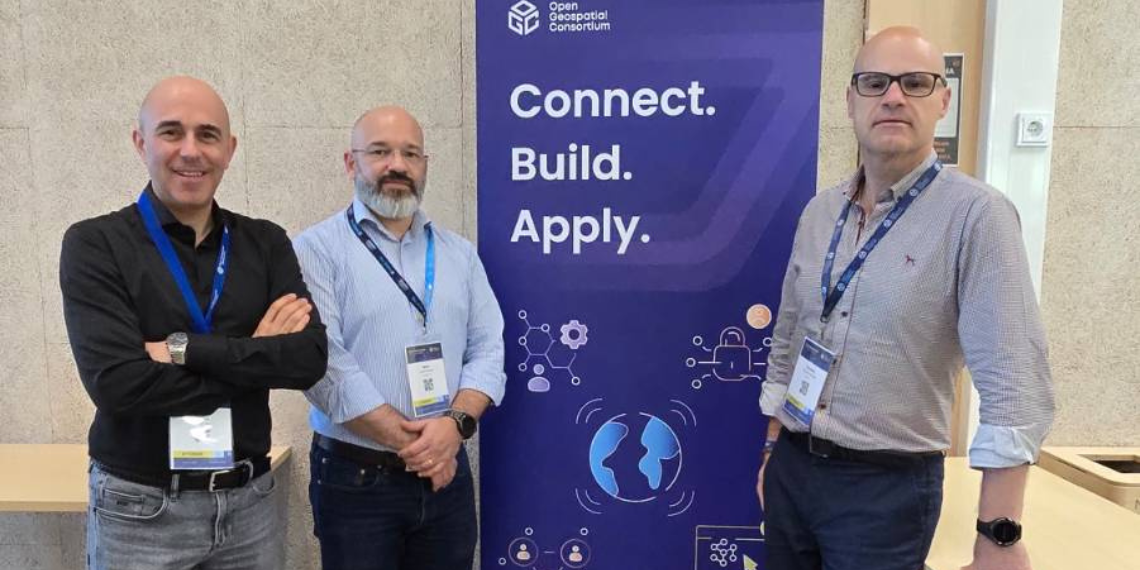
The Institute’s researchers Lino Oliveira and Fernando Cassola Marques were also part of the team that took part in technical sessions and working groups focused on the development of open standards for geospatial interoperability, Digital Twins, Data Spaces and distributed digital infrastructures. In addition to the technical presentation, the team’s participation provided an opportunity to closely follow the latest trends within the international community, strengthen partnerships with other institutions and contribute to defining new areas of work in emerging fields such as GeoAI, federated Digital Twins and open digital infrastructures, further strengthening Portugal’s position at the forefront of international geospatial research.
This participation is part of a broader body of work that INESC TEC has been developing through several national and European projects focused on Digital Twins, Data Spaces, semantic interoperability and FAIR workflows. The work aims to create solutions that enable applications, data and computing resources to be reused across different platforms and scientific domains – an important step towards making research more efficient and collaborative at international level.
 News, current topics, curiosities and so much more about INESC TEC and its community!
