


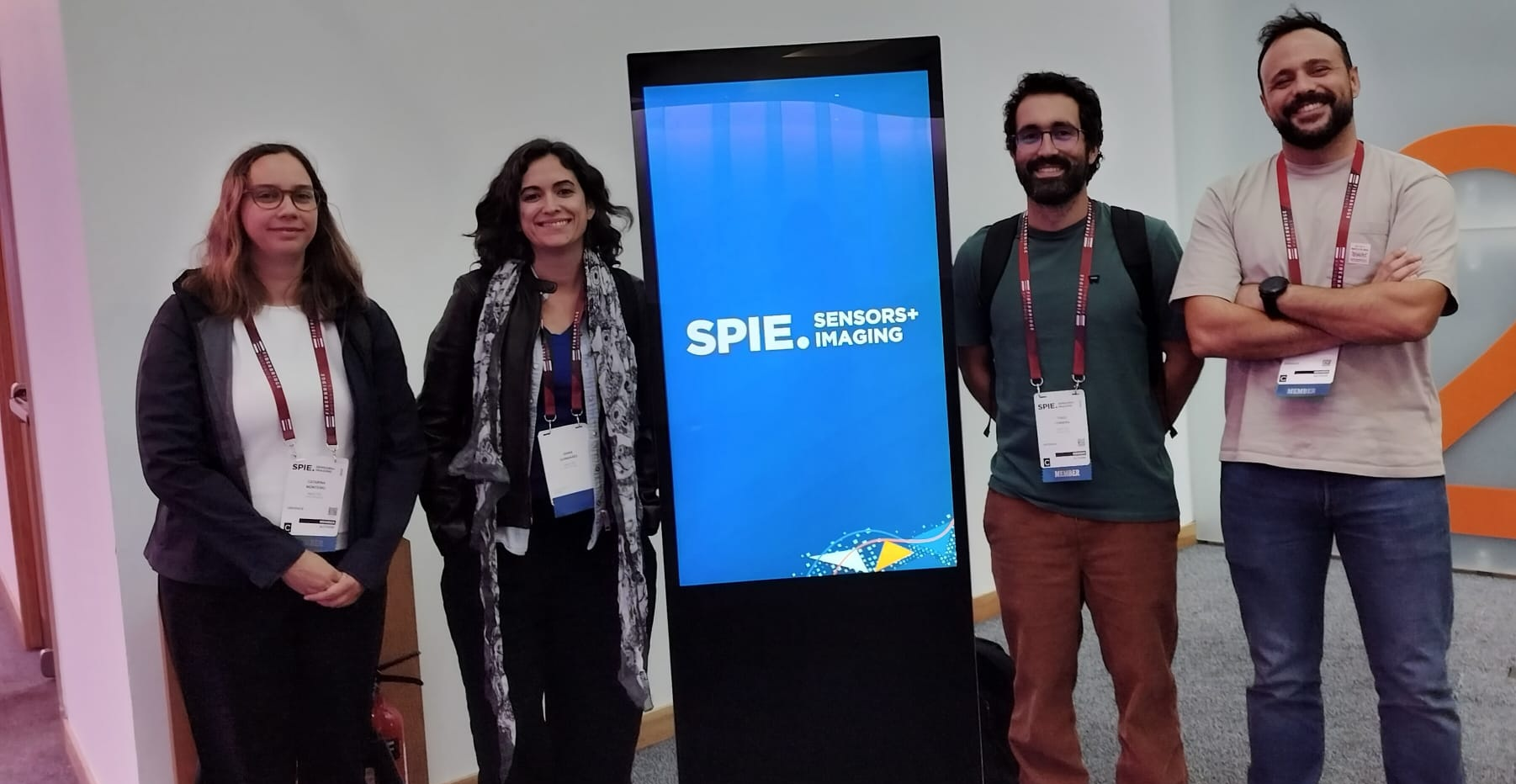
SPIE Sensors + Imaging is one of Europe’s leading conferences in the field of sensors and photonics. This year it was held in Edinburgh (Scotland) in mid-September, and four INESC TEC researchers flew there to present their work on optical fibre, artificial intelligence for sensors and quantum imaging. Four papers were presented, along with an invited talk.
The conference brought together researchers and professionals from the fields of sensing, imaging and photonics to discuss recent scientific and technological developments, with applications ranging from remote sensing and environmental monitoring to security and defence.
Catarina Monteiro, Diana Guimarães, Nuno Silva and Tiago Ferreira were the INESC TEC researchers, working in photonics, who contributed to the scientific programme with five oral presentations, including an invited talk. The work presented showcased different lines of research under way at INESC TEC, covering optical fibre sensing, reconfigurable optical computing and sensor interrogation optimisation, spectral data analysis and quantum imaging.
One of the highlights of INESC TEC’s participation was the invited talk ‘Multipoint fiber-optic sensing via sensor fusion of speckle and polarization interrogation’, given by Catarina Monteiro. A new approach to optical fibre sensing combines event cameras with measurement of the polarisation of light in order to locate vibrations and reconstruct how they evolve over time. By exploiting the complementary information from these two modalities, the system can monitor disturbances with high spatial resolution and across a wide range of frequencies. The technology could contribute to more compact and efficient solutions for structural monitoring, surveillance of critical infrastructure and predictive maintenance.
In addition to the talk, Catarina Monteiro also presented the paper ‘Low-SWaP optical fiber acoustic sensor for underwater vehicles with event-based interrogation’, which focuses on a compact and efficient optical fibre acoustic sensing solution for underwater vehicles. The event-camera-based approach reduces the amount of data to be processed while preserving the most relevant acoustic information, an advantage that is particularly important on platforms with constraints on size, weight and power consumption.
Reconfigurable optical computing and sensor interrogation optimisation were also among the topics in the spotlight. Nuno Silva presented the paper ‘Evolutionary and reinforcement learning strategies for all-optical speckle sensing interrogation’, which explored evolutionary algorithms and reinforcement learning strategies to optimise the interrogation of speckle-based optical sensors. The approach seeks to increase the adaptability and efficiency of these systems by automatically identifying the most informative optical configurations.
Diana Guimarães presented the paper ‘Multi-scale spectral data fusion and knowledge distillation for resource and environmental remote sensing’. The study focused on combining spectral information acquired at different scales and on transferring knowledge between artificial intelligence models. This approach could contribute to more efficient analysis of complex spectral data, with applications in the characterisation of natural resources and environmental monitoring.
Quantum imaging was another area represented in the programme. Tiago Ferreira presented the paper ‘Polarization-sensitive Hong-Ou-Mandel microscopy for birefringence imaging using narrowband photon pairs’, an approach based on quantum interference phenomena to obtain information about the optical properties of materials. The technique exploits the interaction between photon pairs and birefringent samples, making it possible to access information that can be difficult to obtain using conventional imaging methods.
INESC TEC’s participation in this conference reflects the diversity of the research carried out at the Institute in the areas of sensing and imaging, from optical fibre technologies and underwater applications to sensor interrogation optimisation, remote sensing and quantum technologies.
Disclaimer: This article was translated by Claude.
 News, current topics, curiosities and so much more about INESC TEC and its community!
