


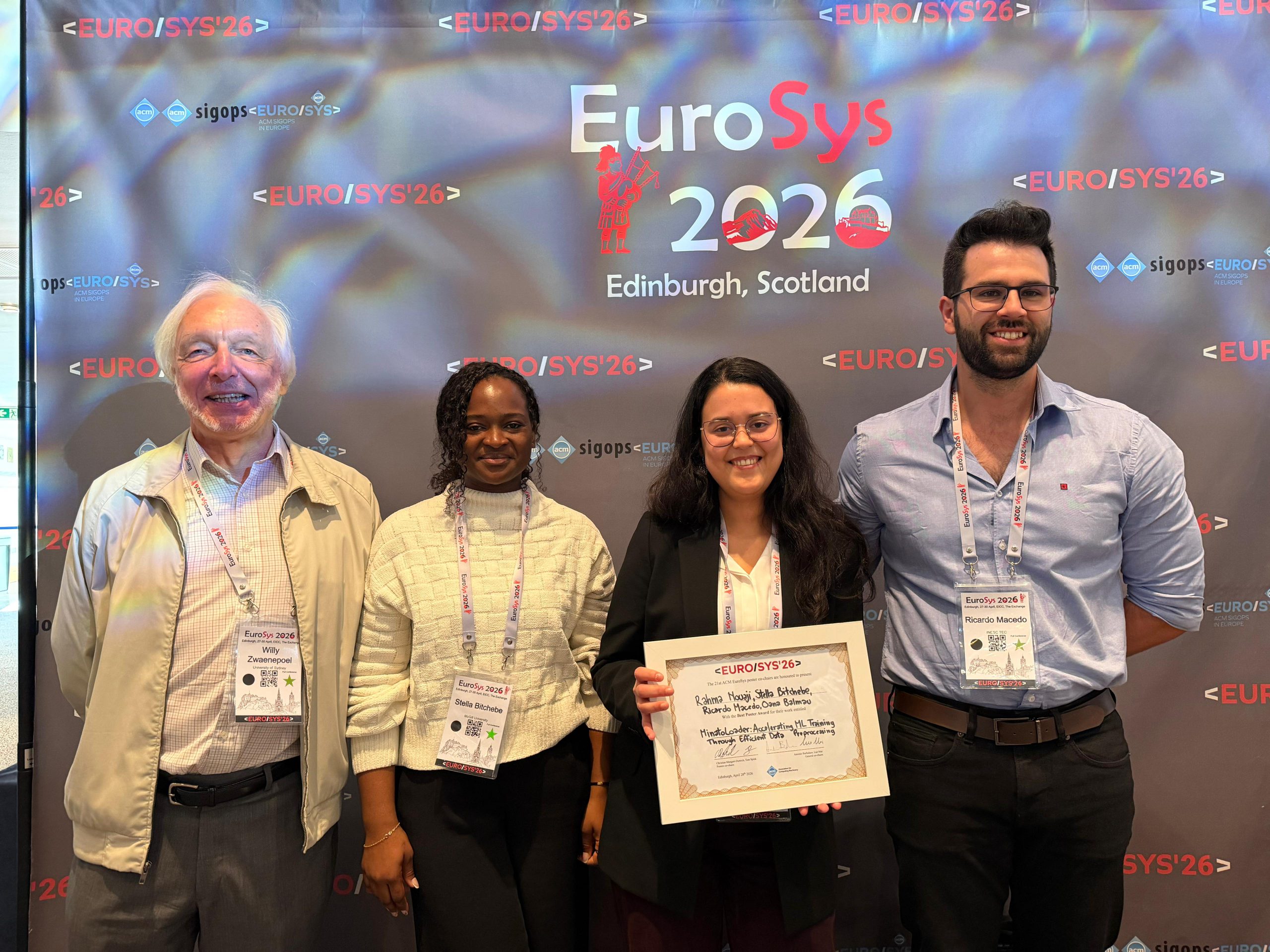
From a best poster award to contributions on four distinct fronts. That is how INESC TEC made its mark at EuroSys 2026, one of the most prestigious international conferences in computer systems.
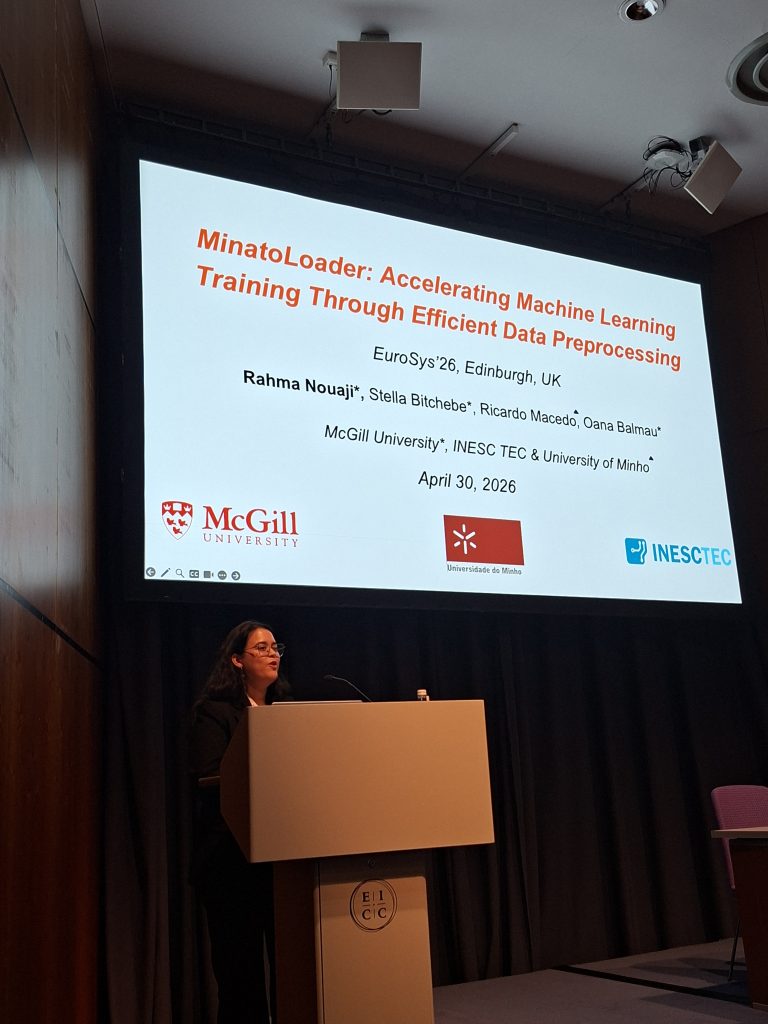
The highlight was the presentation of the paper “MinatoLoader: Accelerating Machine Learning Training Through Efficient Data Preprocessing“, authored by Rahma Nouaji, a researcher at McGill University in Canada, co-authored with Ricardo Macedo, a researcher at INESC TEC, and Stella Bitchebe and Oana Balmau, also from McGill University.
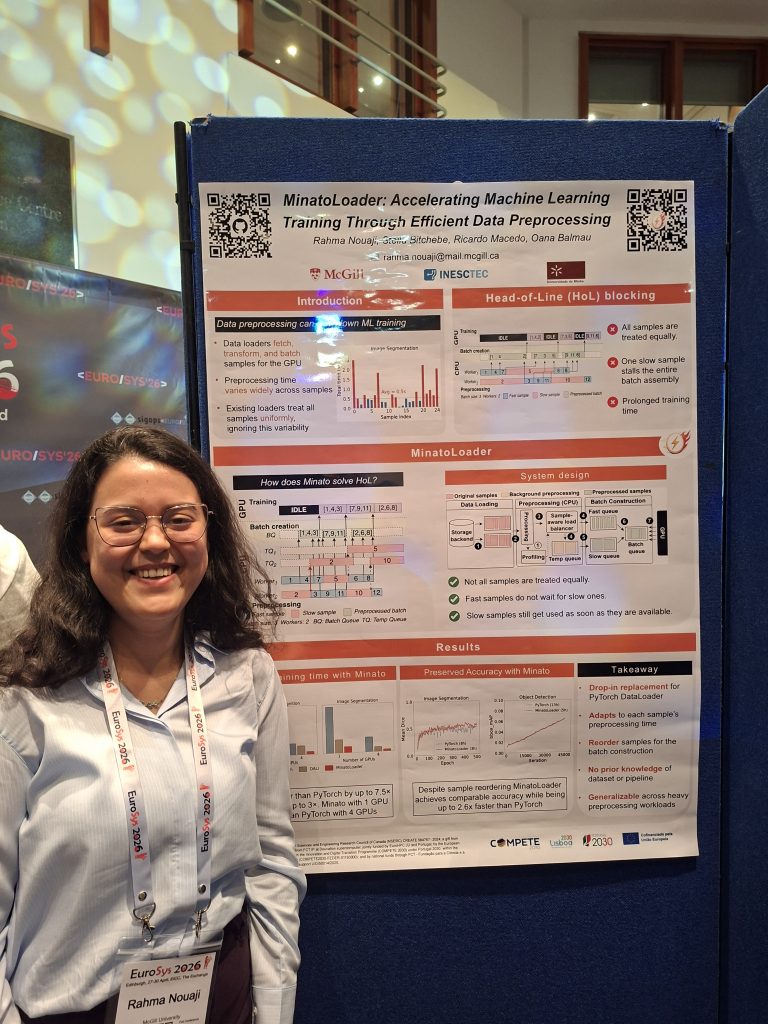
The work proposes a new data loader for PyTorch that eliminates one of the main bottlenecks in machine learning model training: GPU idleness caused by delays in data preprocessing. Unlike existing solutions, MinatoLoader dynamically prioritises the fastest samples to process when building each batch, keeping the GPU continuously fed while slower samples are processed in parallel. The results demonstrate reductions in total training time of up to 7.5× compared to PyTorch DataLoader and up to 3× compared to NVIDIA DALI, increasing average GPU utilisation from 46% to 90% without compromising model accuracy. The work also gave rise to a poster presented at the conference, which was distinguished with one of the best poster awards, recognising and underscoring the international reach of the work.
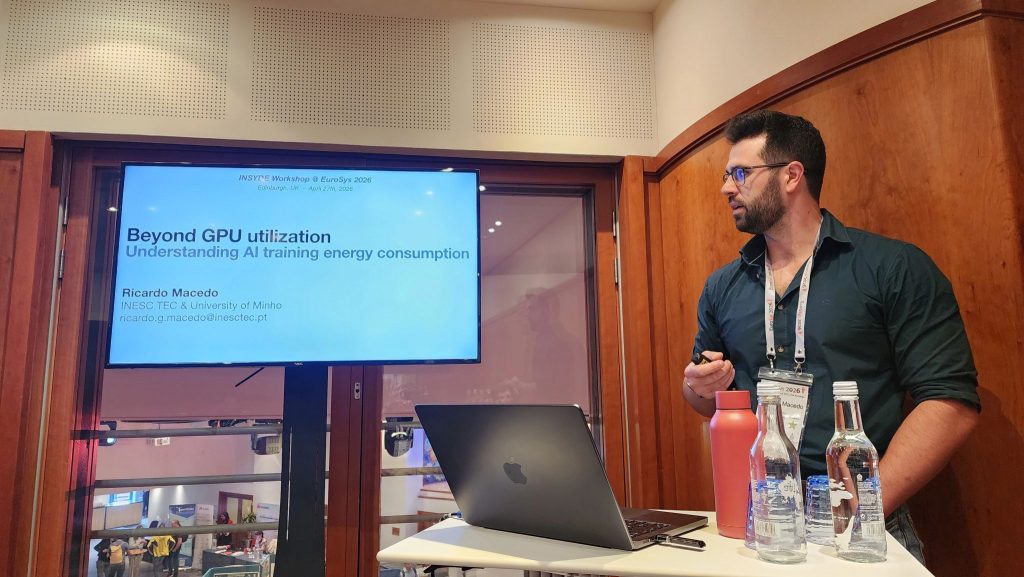
Ricardo Macedo also took part in the Workshop on Intelligent System Design (InSyDe) 2026, where he delivered the talk “Beyond GPU Utilization: Understanding AI Training Energy Consumption”. His intervention broadened the debate around efficiency in artificial intelligence (AI) training, going beyond computational performance metrics to address energy consumption as a central dimension in the design of intelligent systems.
Within the PAPOC workshop, held alongside EuroSys, INESC TEC was represented at several levels. José Orlando Pereira, a researcher at INESC TEC and lecturer at the School of Engineering of the University of Minho, served on the workshop’s programme committee as co-chair, while Francisco Maia and Carlos Baquero, lecturers at the Faculty of Engineering of the University of Porto and also researchers at INESC TEC, presented the paper entitled “Bounding Byzantine Impact in Open CRDT Systems“, dedicated to analysing the impact of Byzantine faults in open CRDT systems — a relevant contribution to the field of fault-tolerant distributed systems.
INESC TEC’s participation at EuroSys 2026, held from 27 to 30 April in Edinburgh, United Kingdom, reflects the institution’s growing international visibility in the areas of computer systems, machine learning, and distributed systems, consolidating its active role at the frontier of scientific knowledge in these fields.
Disclaimer: this news piece was translated by Claude.ai
 News, current topics, curiosities and so much more about INESC TEC and its community!
