


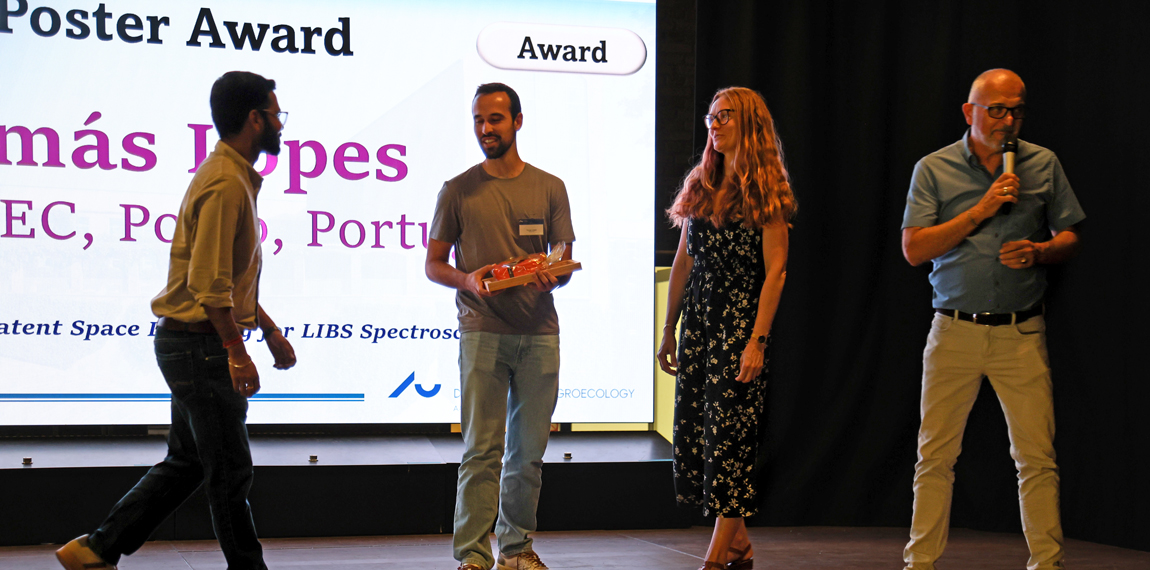
An INESC TEC researcher has received an award at a conference dedicated to Laser-Induced Breakdown Spectroscopy (LIBS); his research uses machine learning to identify the most significant features and patterns in spectral data, extracting the information that matters most for analysis.
Spectral data contains vast amounts of information, but it is typically sparse, with only a small fraction proving genuinely useful. What if researchers could represent this data in a compact form while retaining the valuable information needed for analysis, multimodal applications and classification tasks?
That question earned INESC TEC researcher Tomás Lopes the Best Poster Award at the Nordic Laser-Induced Breakdown Spectroscopy (LIBS) Symposium, held in Aarhus, Denmark. His project, Self-supervised Latent Space Learning for LIBS Spectroscopy, is part of INESC TEC’s research into LIBS, aiming to support the development of more resilient industrial systems.
“This work presents a preliminary study that uses self-supervised learning methods to reduce the dimensionality of the acquired data,” explained the researcher. The study reflects INESC TEC’s research team’s interest in developing multimodal systems with more autonomous learning capabilities. It focuses on identifying the features and patterns that preserve the most important information contained in spectral data.
“It’s a complex task,” said Tomás Lopes. The proposed approach could prove particularly valuable in industrial systems, as it relies on a learning model that identifies essential information without depending directly on manual annotations. A simple example helps illustrate the concept: imagine two photographs of the same object, although one has suffered significant degradation and contains considerable noise. Despite these differences, both images clearly depict the same object. Just as the model focuses on the defining characteristics of the object while ignoring variations that do not change the image’s essential content, the researchers trained it to distinguish irrelevant variations from the truly meaningful information contained in spectral data.
According to Tomás Lopes, this approach could make industrial systems more resilient when dealing with new samples, different acquisition conditions or gradual changes in manufacturing processes. It could also pave the way for continuous learning strategies.
The second edition of the Nordic Laser-Induced Breakdown Spectroscopy Symposium took place on 24 and 25 June, bringing together researchers from academia and industry, as well as students, to discuss the latest advances in LIBS and other spectroscopic techniques.
“Overall, it was a very positive experience, both because of the opportunity to engage with a different research environment and because of the chance to experience the city,” Tomás Lopes concluded.
 News, current topics, curiosities and so much more about INESC TEC and its community!
