


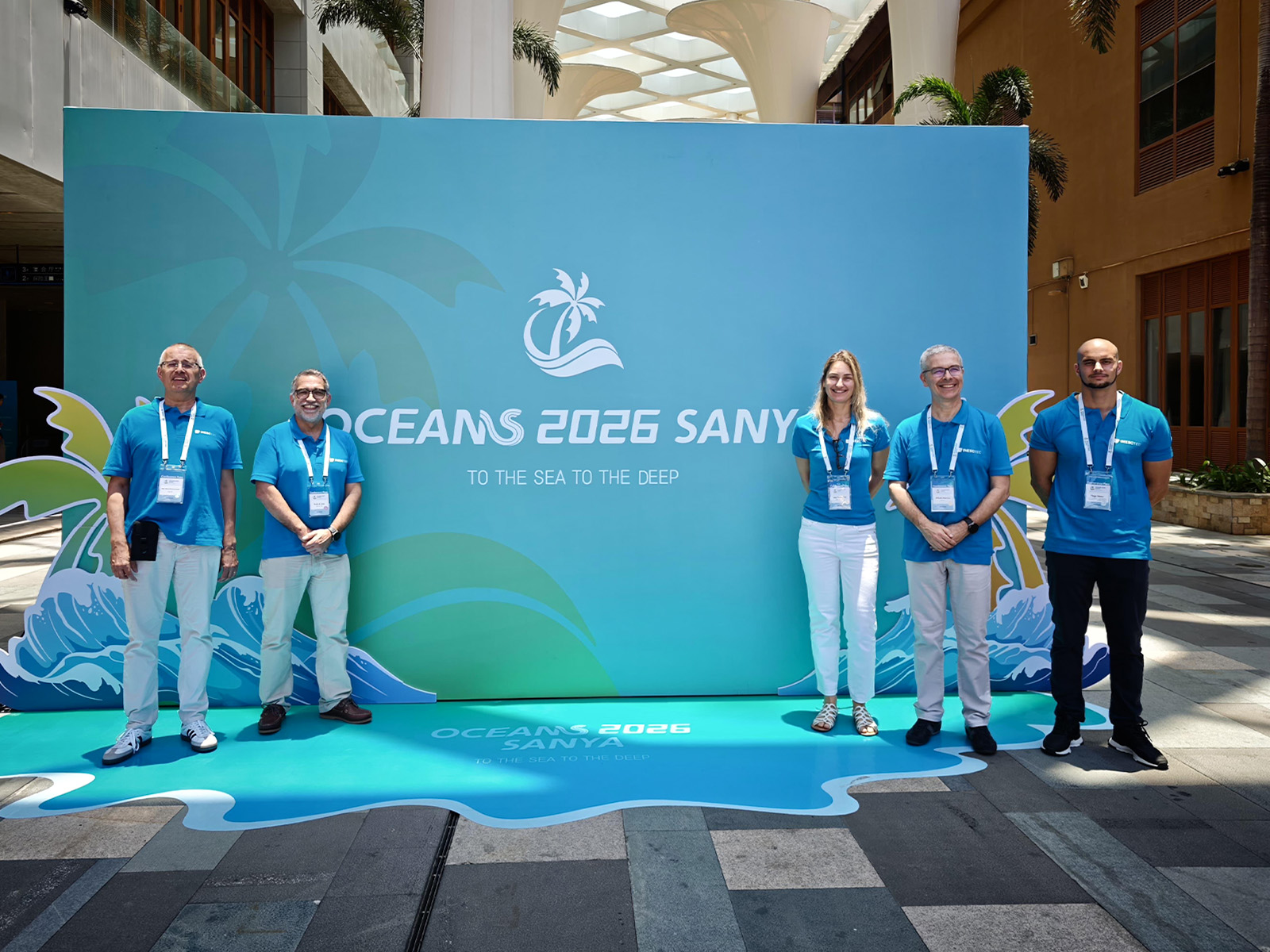
At the latest edition of the OCEANS conference, held in China, INESC TEC had the opportunity to highlight the scope and diversity of the Institute’s work in developing robotic solutions for ocean environments. The agenda also included a keynote lecture at a university and participation in an autonomous underwater vehicle competition.
Nine papers, five researchers and three events: that was INESC TEC’s programme during the visit to Sanya, a coastal city on China’s Hainan Island. The team, led by researcher Nuno Cruz (who coordinates the Institute’s Robotics and Autonomous Systems area), also included researchers Paula Lima, Pedro Guedes, Alfredo Martins and Tiago Matos.
INESC TEC is now a regular participant at the OCEANS conferences, organised by the IEEE Oceanic Engineering Society. Following the 2025 editions in Brest and Chicago, the Sanya conference was no exception, with the Institute’s team presenting a total of nine scientific papers.
According to Nuno Cruz, the presentations covered topics including the autonomous navigation and docking of surface vehicles, launch and recovery systems for underwater vehicles, offshore mission planning, underwater electromagnetic surveying, the development of bio-inspired flow sensors, and the robotic collection of environmental DNA samples.
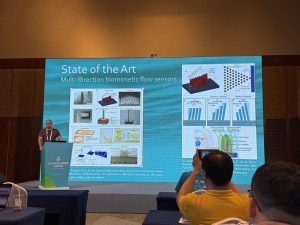
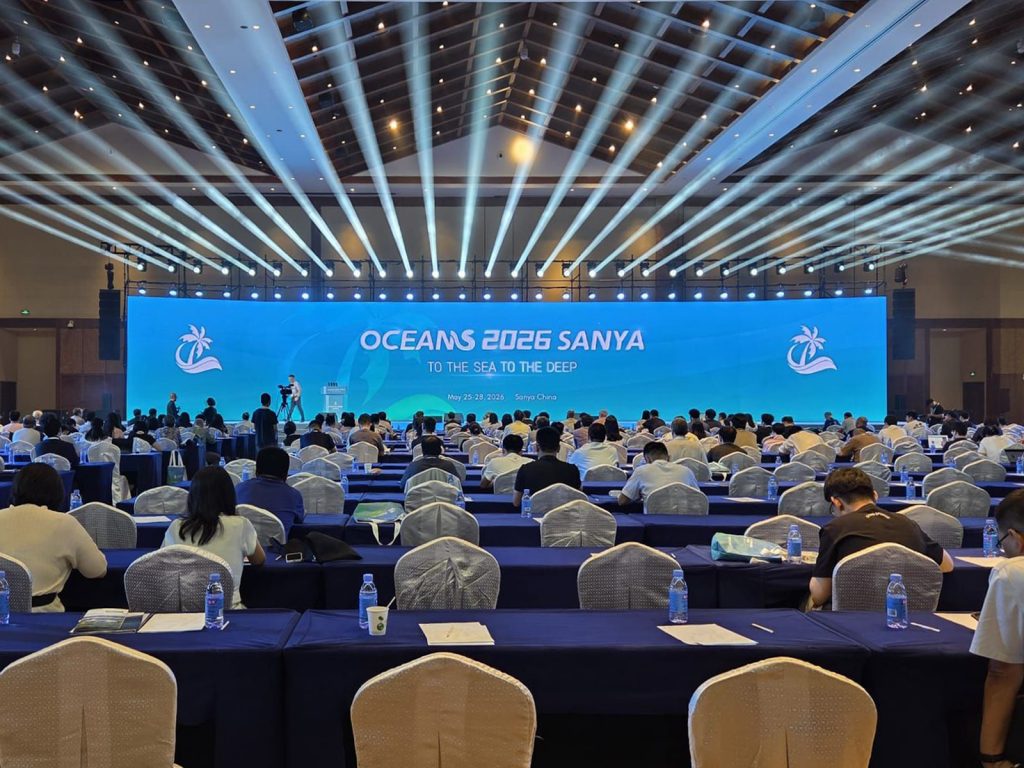
The team’s contributions extended well beyond these topics. Other papers focused on areas such as the ecological characterisation of seamounts, linked to the oceanographic expedition to the Madeira-Tore geological complex, during which INESC TEC supported ocean data collection using the autonomous vehicle EVA; the robotic exploration of mines, as demonstrated through the MINE.IO project, in which the Institute played an active role in developing robotic solutions to support the digitalisation and sustainability of mining operations; and the localisation of fishing gear, one of the core objectives of the NETTAG+ project, in which INESC TEC’s IRIS robot demonstrated the ability to detect marine litter originating from fishing activities autonomously and accurately.
This broad-ranging participation highlighted what Nuno Cruz, who is also a lecturer at the Faculty of Engineering of the University of Porto (FEUP), described as the “range and diversity of the work carried out in marine robotics” at INESC TEC.
According to the researcher, the team’s participation reflected the ongoing research and innovation activities within the Robotics and Autonomous Systems area, particularly in navigation and control, perception, localisation and mapping, platforms and operations, component development, system prototyping, and cooperative operations.
“Our work seeks to transform scientific research into technologies that have been validated in real-world scenarios, with applications in environmental monitoring, infrastructure inspection, the sustainable exploration of the ocean and offshore renewable energy.”
Alongside the conference, Nuno Cruz was also invited to visit the local campus of the Harbin Engineering University (Nahai Institute of Harbin Engineering University), located in the Yazhou Bay Science and Technology City in Sanya. There, he delivered a keynote lecture at the Forum on Marine Acoustics and Information Technology, a workshop dedicated to marine acoustics and information technologies.
During his presentation, Marine Robotics in the Real World: Systems, Challenges and Opportunities, Nuno Cruz provided “an overview of marine robotics research at INESC TEC, including the main robotic systems, technical expertise, international projects and the challenges associated with long-term autonomy and the robust operation of robotic vehicles in demanding maritime environments”.
However, INESC TEC’s programme in China continued for a few more days, with Nuno Cruz serving as a judge at the Singapore AUV Challenge, an autonomous underwater vehicle competition. The 2026 edition, also held in Sanya, challenged teams to “design and develop fully autonomous underwater vehicles capable of carrying out tasks inspired by real-world operations, including navigation, visual identification, acoustic localisation and manipulation”, the researcher explained.
According to Nuno Cruz, the competition “plays a particularly important role in the education of engineering students by providing a multidisciplinary learning experience; it brings together mechanical engineering, electronics, programming, systems integration and experimental validation.”
The researcher also highlighted how the competition fosters teamwork and encourages the development of “creative solutions to real-world problems”, while promoting interaction with international experts and inspiring future careers in marine robotics.
 News, current topics, curiosities and so much more about INESC TEC and its community!
