


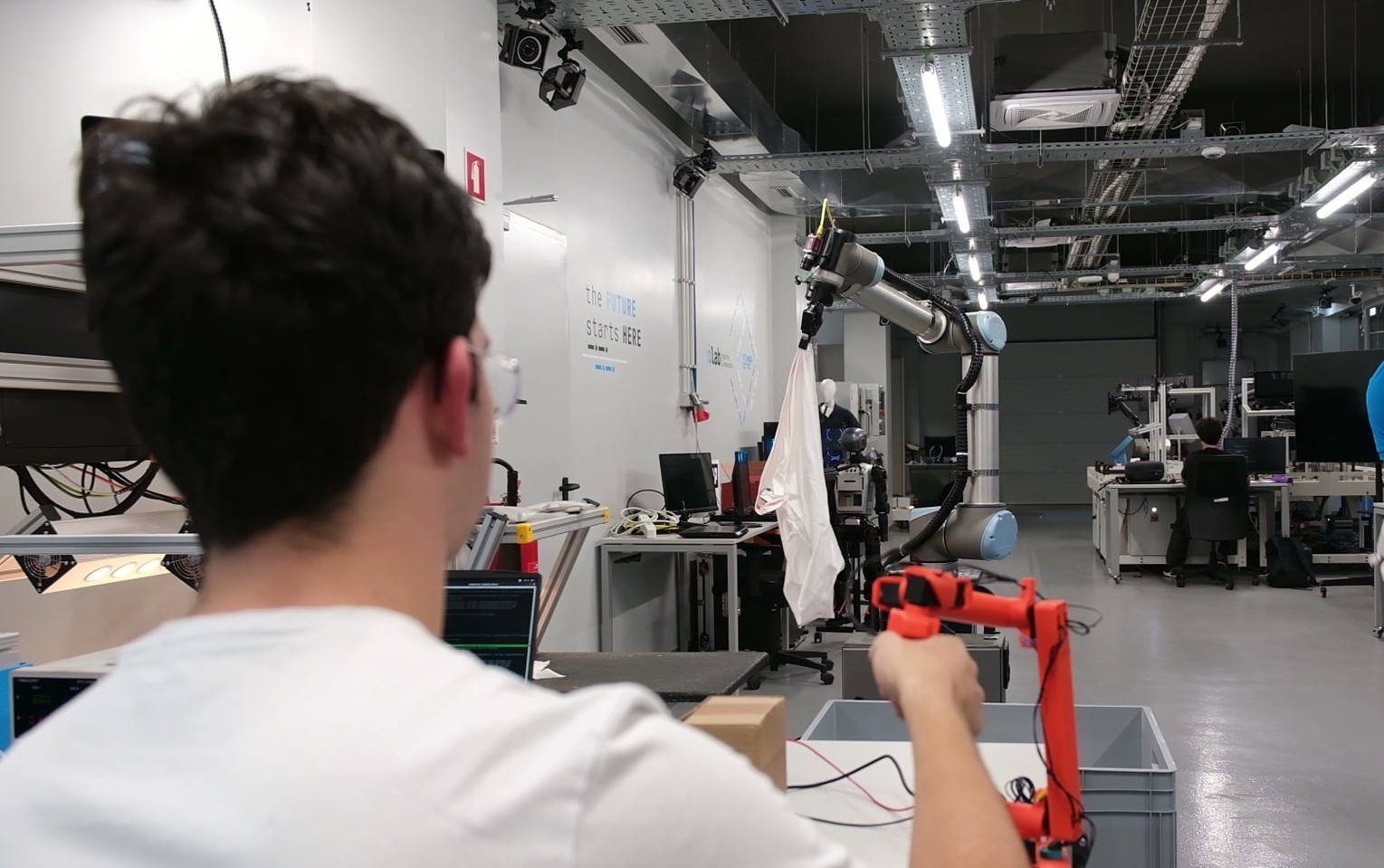
How can technology be used to create sustainable businesses? That was the challenge set for a group of seven high school students who chose INESC TEC for a unique scientific experience designed to inspire their future careers.
The programme, entitled Nada se perde, tudo se transforma: como é que a tecnologia ajuda na sustentabilidade, took place between 20 and 24 July. Over the course of the week, participants explored a range of INESC TEC projects addressing sustainability from environmental, economic and social perspectives. Through activities spanning industrial engineering and management, robotics and AI, the programme combined theoretical training, hands-on experiences and mentoring by researchers across several of INESC TEC’s research infrastructures. The aim was to demonstrate how technology can contribute to a more sustainable, people-centred society. At the end of the programme, students developed and pitched innovative, tech-based and sustainable business models, presenting solutions to a variety of everyday challenges.
“For me, it was a real pleasure to support the students from the moment the challenge was introduced through to the final pitch,” said Ana Simões, an INESC TEC researcher in the field of industrial engineering and systems management. “Watching their Business Model Canvas take shape session after session was incredibly rewarding.” The Scientific Coordinator of this year’s programme added that “the students showed a great deal of interest in sustainability, asked thoughtful questions and brought forward ideas of their own.”
Romão Santos, INESC TEC researcher working in the same research area, also described the experience as highly positive. Responsible for the session on sustainable decision-making in organisations, he said that “participants showed a high level of engagement, contributing actively to discussions on different approaches to decision support.” He added that “initiatives like this clearly help participants develop valuable skills for both their academic journey and their future careers.”
The practical sessions on industrial robotics took place at iilab – INESC TEC’s Industry and Innovation Laboratory. Daniel Lopes, an INESC TEC researcher and one of the session supervisors, said that “it was a pleasure to work with the students and introduce them to some of the technologies the Institute is developing in the field of recycling.” He also stated that “seeing their enthusiasm as they experimented with the teleoperation of a robotic arm made the experience even more rewarding.”
Cristina Guimarães, INESC TEC researcher specialising in innovation and entrepreneurship who led the session on sustainability in business, claimed that “educating for sustainability means encouraging critical thinking so that future entrepreneurs can better understand the challenges of creating sustainable businesses and driving responsible innovation.” Reflecting on the group of students, she said that “what surprised me was not their enthusiasm or intellectual curiosity, but the values they have already embraced. They clearly showed a growing commitment to regenerating ecosystems and making them more resilient.”
During the sessions dedicated to developing their business models, the students were also mentored by Ariane Ávila, an INESC TEC researcher in the field of engineering and management. “It was inspiring to see each team gradually gain clarity and confidence until they were able to present and defend their business idea with conviction and purpose,” she said.
The group ultimately presented two business concepts: one focused on the treatment and recovery of electronic waste, and another exploring the reuse of radioactive materials.
The programme forms part of Ciência Viva’s national initiative Ocupação Científica de Jovens nas Férias, which takes place every summer and aims to provide high school students direct contact with science and technology developed at leading Portuguese research institutions.
 News, current topics, curiosities and so much more about INESC TEC and its community!
