


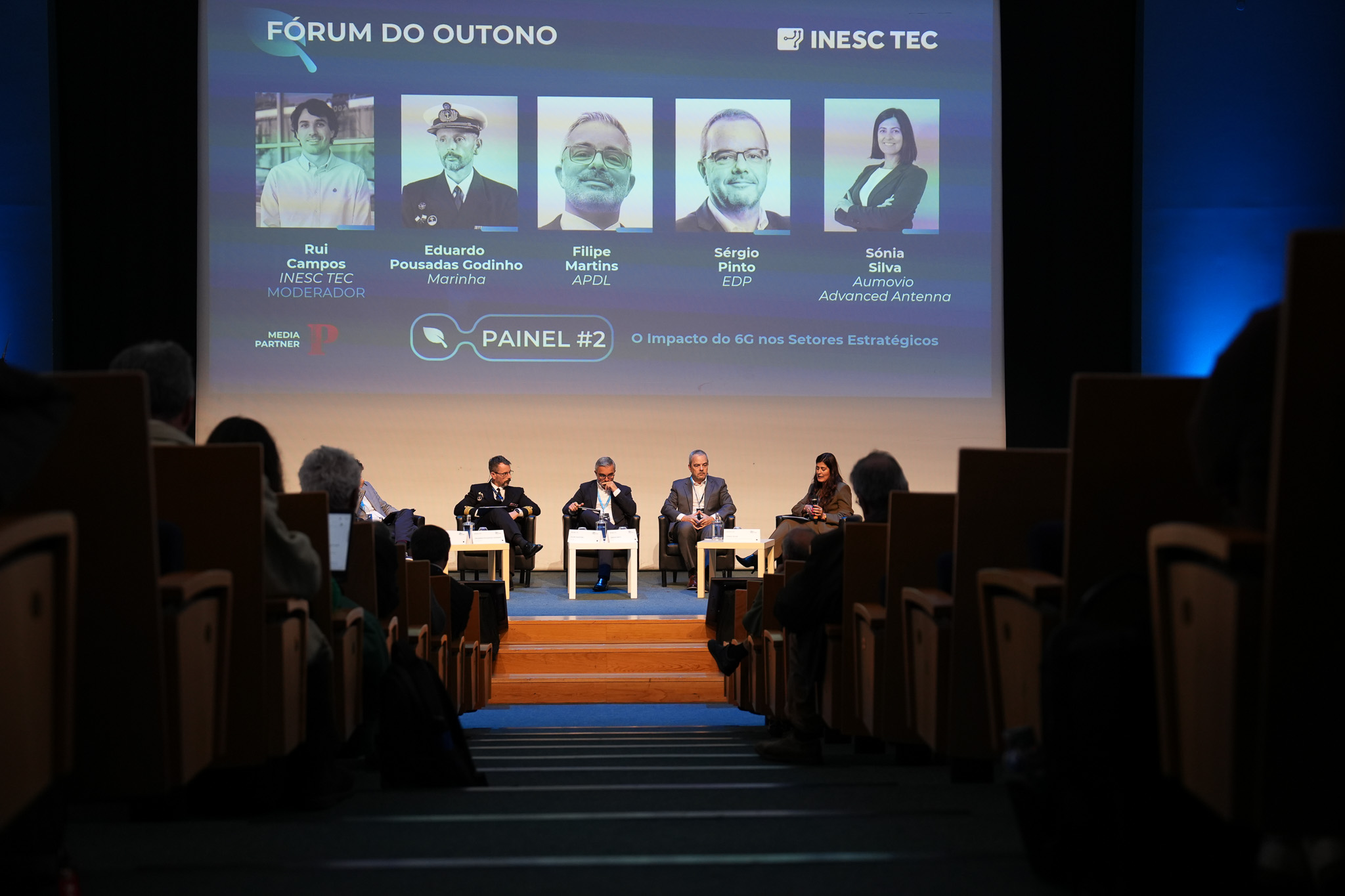
In 2026, the INESC TEC Autumn Forum returned to a familiar venue – the Faculty of Engineering of the University of Porto (FEUP) – to discuss Digital Infrastructures: Technology, Economy and Sovereignty.
Given the importance of this topic across different sectors of society, the event brought together representatives from academia, businesses and public authorities to provide a comprehensive overview of the needs and requirements of 6G, the implementation process and the changes it will bring.
This transformation “makes us dream”, as João Claro, Chairman of INESC TEC, put it during the closing session, following several hours of discussion and the exchange of ideas. The integration of Artificial Intelligence (AI), distributed computing and advanced sensing capabilities were among the key themes of an event whose “impact and longevity” were a source of pride.
One of the main takeaways from the day’s discussions was the need to bring science and technological development closer to industry and to “look collectively at how we can address these challenges”, João Claro emphasised. Part of the answer, for example, lies in the creation of the Laboratory of Communications and Computational Perception, in partnership with FEUP.
One thing is certain: the race towards 6G is advancing, and the 2030 target is closer than ever. Javier Lorca Hernando, Senior Consultant at InterDigital, brought his vision of the future of digital infrastructures to the INESC TEC Autumn Forum, describing networks “equipped” with AI and sensing capabilities that can observe the physical world, interpret information, make decisions and take action.
Javier Lorca Hernando looked back at 2023, when the International Telecommunication Union (ITU) established the framework for 6G development. The new generation promises to be faster, more capable and to offer lower latency than its predecessor. Final recommendations are expected in 2030, but the challenges are considerable. Alongside the further development of 5G capabilities, three new use cases are emerging: the integration of AI into communications, ubiquitous connectivity, and the integration of sensing and communication capabilities (Integrated Sensing and Communication – ISAC).
In practical terms, the latter will “give the network eyes”, explained the expert, who delivered the day’s first keynote. Using radio-frequency signals themselves, communication infrastructures will be able to perceive their physical surroundings, detecting people and objects even when they are not connected to the network.
In a factory environment, for example, this capability could help improve coordination between people, machines and robots. And while ISAC allows the network to observe, Artificial Intelligence enables it to interpret, decide and act -giving it agency as well as vision.
According to Javier Lorca Hernando, the speed at which AI is evolving, which is faster than that of telecommunications systems, makes it difficult to anticipate the impact on future infrastructures.
But how far do we want a network to be able to see? And what decisions are we willing to entrust to intelligent networks? Javier Lorca Hernando outlined one possible scenario: a network could even collect information about people who had never intended to interact with it. “Sensing capabilities make it possible to monitor human characteristics, breathing and the presence of people through walls, and this entails significant legal obligations under the EU’s General Data Protection Regulation (GDPR) and Data Act.”
Privacy, consent, transparency, security and data ownership play a central role in 6G development. The first half of the Autumn Forum also offered another perspective. Francisco Fontes, from Altice Labs, delivered the second keynote, presenting the network operator’s point of view and outlining the societal and technological challenges, as well as the context for the coming years – a period that, ultimately, is expected to be defined by “convergence”.
Against a backdrop of climate change, geopolitical tensions, an ageing population and growing energy consumption, driven in part by the expansion of AI and its application across different sectors, networks are also facing increasing complexity, spectrum scarcity, rising data volumes and the quantum threat to cryptography. In this context, non-terrestrial networks (NTN) and 6G remain part of the answer, providing what Francisco Fontes envisaged as connectivity across “land, air and space”.
Quantum technologies are currently regarded as a potential threat to networks. Altice Labs is already preparing for the much-anticipated Q-Day: the day when a sufficiently powerful quantum computer will be able to break the public-key cryptography that currently protects communications. The company was responsible for designing and implementing a Software-Defined Networking (SDN)-based solution and is also a member of IberianQCI and the EuroQCI initiative.
Although the technology is not expected to reach full maturity until between 2029 and 2038, Francisco Fontes pointed out that some organisations are already collecting encrypted data with a view to decrypting it at a later stage. This makes the transition to post-quantum encryption a necessary and urgent step, with 6G expected to incorporate these technologies.
The new generation of telecommunications has been received with different approaches. On the one hand are the cautious players, focused on recovering the substantial investments made during the rollout of 5G and favouring more efficient use of resources as they move towards an improved version of the previous technology. On the other are the innovators, a group in which the expert placed Altice Labs, which is committed to testing, research and development of AI-native architectures that help shape standardisation. He also identified a third group, comprising those aligned with hyperscalers, satellite operators and cloud providers, which view the network as a software platform and an ecosystem of APIs.
For Francisco Fontes, “the future lies in connecting everything: land, air and space”. He described the goal as “a single intelligent, secure and programmable network, all built on connectivity for an increasingly digital society”.
The second part of the INESC TEC Autumn Forum featured two panel discussions. The first, entitled “Portugal in the Race towards 6G – Research, Innovation and Opportunities”, was moderated by Luís Pessoa, an INESC TEC researcher and lecturer at FEUP. It highlighted the idea that Portugal should focus on business opportunities beyond hardware manufacturing, including software, AI and cybersecurity. According to Marília Curado (IPN/FCTUC), there are “products and services for which we have the capabilities, knowledge and experience”, as well as application areas where companies with innovative ideas can develop solutions and contribute to the 6G landscape.
According to Mário Rui Santos, from Wavecom, the connection between the business sector and Portugal’s R&D ecosystem “works well”. The main difficulties in moving from research to the market occur further down the line, during certification and when securing funding for the so-called go-to-market phase. “It takes a long time for the products we develop to achieve success. A customer in the domestic market carries little weight internationally, as their credibility as a reference is limited. We need to be able to persevere, keeping the company active and continuing to invest”, he pointed out.
Despite all the shortcomings (and the regulatory obstacles highlighted by many) that Clara Gonçalves acknowledged in the European project, the fact that Europe is the only bloc concerned with setting limits on innovation was seen as an opportunity: “a different way of looking at the problem”. “Legislation must exist. Europe can automate processes, but it must never forget the importance of regulation.” The Director of Research Partnerships at TEKEVER concluded her contribution by stating that “Europe is the best continent to live in. There is room for improvement, but we must maintain the principle that regulation matters.”
“Resilience, resilience, resilience.” This was how Rui Campos – the INESC TEC researcher and lecturer at the Faculty of Engineering of the University of Porto who moderated the day’s final panel – summed up the last exchange of ideas at the Autumn Forum. The discussion explored the impact of 6G on strategic sectors, taking the conversation beyond theory and into practical considerations to understand the benefits and challenges for these sectors.
From the Navy to the automotive industry, as well as port operations and the energy sector, the focus shifted to operational challenges and the need to ensure that the next steps address real-world requirements.
Let’s look at some examples. Sérgio Pinto, from EDP, summed up the importance of communications in the energy sector: “Without communications, there is no energy; they are an integral part of the electricity system.” For the Director of Infrastructures at the electricity generation, distribution and supply company, building resilience is the main challenge. Greater “resilience” can make responses to scenarios such as the Iberian Peninsula blackout more robust.
And what would happen in such a scenario to a warship out at sea, for example? Eduardo Pousadas Godinho outlined what can happen when there is greater dependence on external systems: “A ship connected to a 5G network has internal mechanisms that allow it, for example, to generate electricity. But when we change the paradigm, moving towards a cloud-based 6G scenario, we become vulnerable in this area. There will be many challenges.”
For the Navy, Eduardo Pousadas Godinho added, it is “important” for any technological development to prioritise one key requirement: “resilience”. “The ability to continue operating even in degraded environments, together with security, autonomy, independence and interoperability, is essential”, he concluded.
The same statement could almost have been made by Filipe Martins, representing the Douro and Leixões Ports Authority (APDL). At a critical infrastructure site such as the Port of Leixões, communications are essential to day-to-day operations.
“I have previously said that, with 5G networks, low latency was the icing on the cake. Now, the icing is the additional capability that these networks can bring to an infrastructure like ours: a closed environment with access control, where we can detect objects, vessels and non-cooperative people”, Filipe Martins stressed.
And beyond critical infrastructures, how can networks that promise a more competitive and strategically autonomous future make a difference? Sónia Silva, from Aumovio Advanced Antenna, provided the answer. “We used to say that a car was a means of transport. Now it is a technology hub, and in the future, it will become much more sophisticated thanks to AI.”
A path forward for Europe
In his summary of the event, Manuel Ricardo, Director of INESC TEC and lecturer at FEUP, restated that digital infrastructures are now essential to different sectors of society, playing a key role in “the functioning of the economy and society, business competitiveness, the provision of public services, and the security and sovereignty of countries”. The transition to 6G, in turn, will have the potential to “change telecommunications networks”, as they “will no longer be just connectivity infrastructures, but will also incorporate radio sensing capabilities, distributed computing and artificial intelligence”.
By addressing this topic, the INESC TEC Autumn Forum aimed to help Portugal prepare for and benefit from these transformations. Manuel Ricardo highlighted two priorities for the country. The first is to strengthen technological capabilities. “We need to develop and test these technologies through pilot projects. This will certainly help us strengthen our technological sovereignty.” The second, the researcher explained, should be to ensure secure and resilient digital infrastructures. “The impact of failures in these infrastructures will continue to grow. What we witnessed during the blackout is just a small indication of what may happen in the future, when we have these sensing and computing capabilities.”
Before the Forum’s final contribution, delivered by the Rector of the University of Porto, Pedro Nuno Teixeira, João Claro highlighted the discussions around the “difficulties, concerns and opportunities” involved in ensuring that Europe has a voice in this context.
 News, current topics, curiosities and so much more about INESC TEC and its community!

