



“The future is already here; it’s just not evenly distributed.” This quote is attributed to the American science fiction author William Gibson, and it perfectly describes the reality of Portuguese industry. While we talk about Artificial Intelligence, digital twins and autonomous robots, many factories still rely on decades-old machinery, manual processes and Excel spreadsheets. Faced with growing challenges associated with efficiency, sustainability and a shortage of skilled labour, the national industry will inevitably have to accelerate digital transformation. One possible response is PRODUTECH R3, a mobilising agenda in which INESC TEC plays a central role.
The key question now is how to integrate these solutions into factories built long before the data era; how to adapt innovation to each company’s reality; how to transform processes without stopping what can never stop. Pedro Senna, Romão Santos and Davide Carneiro help us understand how technology can contribute to making Portuguese industry more competitive at European and international level.
Let us return to the science fiction universe, this time visiting Silo by Hugh Howey: an alternative society built on multiple levels, where old and modern systems coexist in the same space and survival depends on the ability to keep everything operational. What makes the author’s vision particularly interesting (much like William Gibson’s approach) is that this envisioned future feels more plausible than flying cars or teleportation. This Silo, with complex and almost invisible infrastructures, can easily be compared to a factory on Portuguese soil, where very few people truly understand how the entire system works, and many have only learned how to keep it running.
So how do we make new technology coexist with decades of processes, machines, operators and systems that were never designed to communicate with one another?
The challenge of digital transformation is not technological
Pedro Senna, business developer at INESC TEC and project manager in the industrial area, believes this is precisely the mission of PRODUTECH R3: to transform what for decades was seen simply as the “shop floor” into an intelligent, connected ecosystem capable of making real-time decisions. Let us begin with the invisible layer: data flows, systems communicating with each other, platforms capable of interpreting information from different pieces of equipment. (In Silo, the equivalent would be the IT department controlling systems, servers and information flows. Almost no one fully understands how it all works; they only know the system keeps running.)
“Modern industrial systems must ensure that machines, sensors, software and different platforms can communicate with each other, even when they were developed in different eras, languages and technologies. In essence, we create what we call a semantic engine: a system capable of translating and interpreting different technological ‘languages’,” said Pedro Senna. And this “translation” often begins with machines that are 30 or 40 years old: “There are factories where operators still need to physically connect a laptop to a machine to download data. In others, there are fully functional industrial machines that are nevertheless unable to communicate with modern company systems.”
Some companies end up investing in newer machines, but do not truly transform their production processes. A more advanced machine alone does not mean a digitalised industry. This is precisely where so-called retrofitting comes in: modernising old machines without replacing them. “The goal of retrofitting is to make these pieces of equipment intelligent, adding sensors, connectivity and the ability to communicate with the rest of the company’s systems, enabling real-time access to production data, performance, energy consumption or maintenance,” the researcher explained. Romão Santos, also an INESC TEC researcher, goes further: “It is not a simple task. But it is one of the most realistic ways to accelerate the digital transformation of industry without forcing companies to replace their entire industrial base.”
This change goes far beyond technology. It also requires operators to develop new skills. We are moving from Charlie Chaplin’s Modern Times – with a screwdriver in hand performing sequential, repetitive tasks – to a factory where operators must interpret digital information, understand interfaces and make decisions.
According to researcher Davide Carneiro, the real problem in modern industry is not necessarily technological. It is structural, cultural and organisational. “Many companies start from the end,” he argued. “They want to implement Artificial Intelligence (AI) on top of problems without first understanding whether they have the data, processes and people ready. The technology exists, but the adoption depends far more on organisational readiness than on algorithms.” In other words, the challenge of industrial digital transformation is no longer technology, but people, processes and companies’ ability to integrate new tools on the ground. Perhaps this is the great paradox of digital transformation: everyone wants to reach the top of the Silo, but few are willing to descend to the mechanics below.
How do you adapt imperfect and complex systems? The Têxteis Penedo use case
Davide Carneiro has been working on industrial quality control projects using AI, particularly in the textile industry. Within PRODUTECH R3, a solution was developed to detect fabric defects in real time directly on weaving machines at Têxteis Penedo in Guimarães. The goal is to replace slow, reactive manual inspection processes with an intelligent system capable of identifying defects while the fabric is still being produced.
“Currently, many companies perform quality control after production. In textiles, the roll is produced and only days later someone unrolls it to visually search for defects. There are already solutions, but only a few can identify that there is a defect in a specific area of the fabric,” explained the researcher, also a professor at the School of Engineering and Management of the Polytechnic Institute of Porto. The system developed goes further: it uses seven cameras installed by partner Smartex on each loom and computer vision models developed by INESC TEC capable of identifying, classifying and locating defects with precision. “If there is an oil stain, for example, the system can detect it the moment it appears. This allows the loom to be stopped automatically before the defect ruins the entire roll.”
But developing the Artificial Intelligence was only a small part of the challenge. According to Davide Carneiro, the biggest difficulty lay in collecting and preparing the data needed to train the models, which proved incomplete and unrepresentative of reality: defects recorded without coordinates, without classification, or with default values. On top of that, defects were relatively rare. “To train the algorithms, we had to ask the company to deliberately alter the production process and create real defects. This forced production to stop, required changes in loom settings and resulted in material waste.” Another challenge came from the enormous variability of textile patterns. An algorithm trained to recognise defects in a plain fabric could confuse geometric patterns or stripes with actual flaws. To overcome this limitation, the researchers developed a system to generate synthetic data and artificially create new patterns on real images. Do you see? The real challenge is not developing technology but adapting it and making it work in imperfect and complex systems. (No one can simply go down to the lowest level, shut down the infrastructure and start over, at the risk of everything collapsing.)
This type of approach falls within a field known as Zero Defects Manufacturing, which INESC TEC has been exploring since 2020. In essence, it focuses on detecting problems during production rather than only at the finished product stage. Pedro Senna illustrated: “In a sofa, for example, without technology support, it is impossible to know whether the glue was properly applied, whether nails were placed at the correct angle, or whether certain joints were poorly assembled. The problem only appears later, when the customer sits down and the sofa breaks. Imagine being able to detect any failure during the process itself, not at the end.” Life changing, isn’t it?
A full replica of the factory
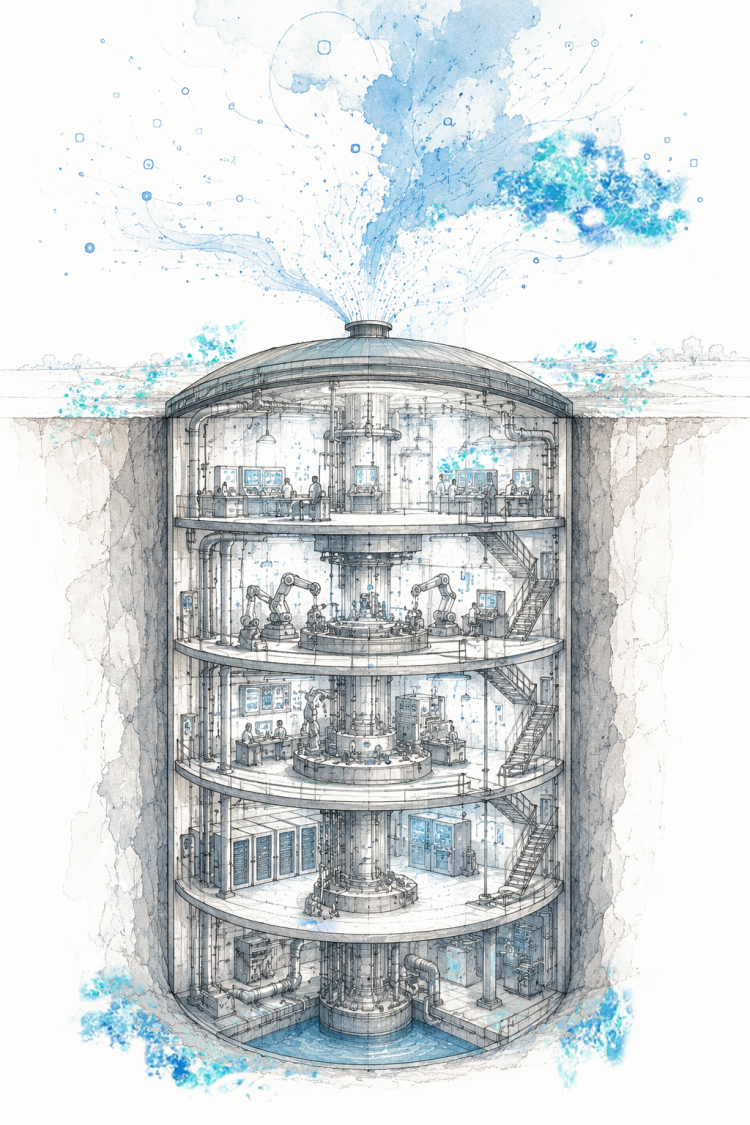
Let us talk about digital twins. In simple terms, a digital twin is a virtual representation of something real: it can be a product, a piece of equipment, an operation, or even an entire factory. (If management had access to such a technology, it might be able to understand and anticipate how each decision would propagate through the different levels of the Silo – not to make the system fairer, because as with AI today, everything depends on who controls the technology and how they choose to use it.)
“At PRODUTECH R3, what we’re developing goes beyond the classical concept of a digital twin. We are virtualising complete industrial processes: production lines, equipment, internal logistics, warehouses, autonomous vehicles and even human operations. It is a dynamic virtual replica. And this allows us to do what we call virtual commissioning,” revealed Pedro Senna. Imagine a factory preparing to manufacture a new product; with virtual commissioning, instead of immediately changing the production line, it can first test different scenarios virtually: understand what changes are needed, what the impact is on costs, productivity and logistics flows. This means reduced risk, cost and adaptation time.
“The goal is creating digital solutions that allow companies to simulate, optimise and manage entire factories in real time. The user selects machines, equipment or resources, and the system automatically generates simulation models capable of predicting performance, waiting times, logistics needs or production impacts. Hence, we can map everything happening in the factory: loading times, routes, movements and system performance. But most importantly, we can also identify when something is wrong,” added Romão Santos. This information can be used for predictive maintenance, one of the areas where industry still faces major difficulties. Today, with this type of solution, it is already possible to understand remotely what happened, receive alerts, analyse sensors and even support maintenance operations at a distance.
The system also includes a library of industrial and logistics equipment, allowing companies to simulate different production scenarios. “We can understand which supplier or piece of equipment delivers the best performance for a given objective. This can also be very useful for entrepreneurs designing factories from scratch,” said Pedro Senna.
And what about people? “Digital twins of operations are practically non-existent in today’s industry, but we already have solutions in this area. We can transform workers into anonymised models through image capture, and analyse working angles, physical effort, ergonomics and repetitive movements,” explained Pedro Senna. The goal is not only to improve productivity, but to understand how to improve working conditions.
INESC TEC has been developing solutions based on computer vision, smart cameras and sensors that generate more accurate and detailed data for industrial simulation models. “The aim is to ensure that the simulation has a source of truth as close to reality as possible,” explained Romão Santos.
Thinking the product from start to finish
There are objects kept across generations – artefacts – circulating between the levels of the Silo. They gain a new life, becoming meaningful rather than mundane. If this is not a metaphor for the circular economy, what is PRODUTECH R3 works precisely on what researchers call Product Lifecycle Management: systems capable of tracking a product’s entire life cycle, from design to reuse, recycling or remanufacturing. The goal is to ensure products can return to the industrial system at the end of their useful life.
“One of the most interesting solutions is the concept of Design for Excellence,” explained Pedro Senna. “The idea is to understand how to design a product so that, in the future, it can be disassembled, reused and reintegrated into the industrial process.” This requires thinking across the entire production chain: suppliers, components, assembly, consumer use and future disassembly. “We have methodologies and tools that allow us to simulate how parts are produced, assembled and later disassembled. It’s a very comprehensive work, because it forces us to think years ahead.”
And speaking of parts, how do you coordinate a maintenance operation that involves dismantling, parts management, tool usage, team allocation and final reassembly? Advanced Planning and Scheduling (APS) systems provide the answer. Pedro Senna illustrated this with a real-world example: “Contrary to what many people imagine, there are moments when an aircraft engine, such as those in Boeing or Airbus planes, must be almost completely dismantled for inspection, maintenance and component replacement. Such an engine can contain between 45,000 and 55,000 parts of very different sizes and shapes.”
The challenge lies in planning the entire process: determining which parts must be removed first, which tools are needed at each stage, which teams should intervene, and how to reassemble everything as quickly and accurately as possible. Can you imagine reaching the end of a LEGO build and realising you forgot to place a single 1×1 brown brick? “In aviation, one of the most regulated industries in the world, every component must meet extremely strict standards. Having a spare part left over is equivalent to restarting a task that may take months.” Planning ensures not only speed, but traceability, quality control and technical validation at every stage.
Across aviation and other sectors, APS systems can also integrate historical data on part conditions, usage cycles, previous inspections and future replacement needs, enabling far more efficient maintenance management.
Logistics: the industry’s giant game of Tetris
A small failure at one level can compromise the entire system. And sometimes, this happens in areas often ignored by companies, yet where major efficiency losses occur. Welcome to the world of logistics and intralogistics.
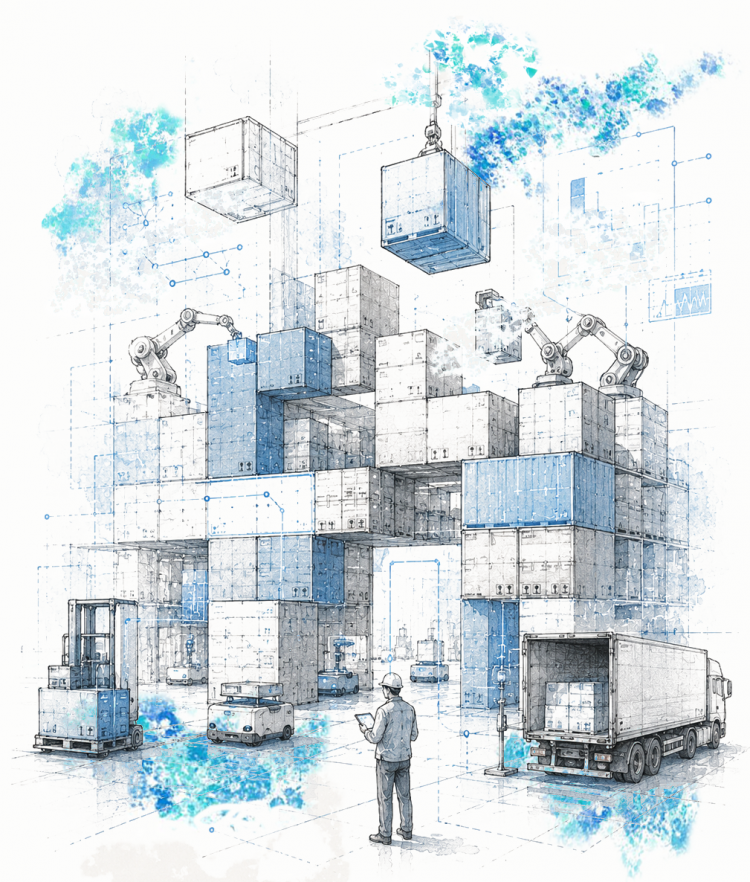
In most industries, production planning is relatively optimised. The problem starts afterwards: how products move, how trucks are loaded, how warehouses are organised, how distribution is handled internally. Much of this still depends on human experience, and researcher Romão Santos used the perfect metaphor: “When loading trucks, operators end up playing a kind of real-time Tetris. With pallets of different sizes and weights, they rely on experience and trial and error to find a solution.”
At INESC TEC, the goal is to replace this process with autonomous systems. One solution under development is an autonomous forklift capable of loading trucks without a human operator. The system combines optimisation algorithms, computer vision, sensors and simulation models capable of automatically calculating the best load distribution inside a truck.
“The algorithm determines the ideal pallet layout, considering weight, stability, volume and even the unloading order at different customers. This is combined with a simulation model that evaluates routes, congestion and operational efficiency,” Romão summarised. Going further, intelligent vehicles can recognise their environment and detect pallet debris, waste, damage or obstacles, triggering alerts. And if the system fails, remote teleoperation is still possible via virtual reality headsets or monitors, allowing the vehicle to be controlled remotely.
In a project with Sonae, for example, a dynamic distribution system for logistics hubs was developed. “Today, many stores have fixed warehouse positions. Our system allows this to be reorganised dynamically based on demand and daily operations.” The results were clear: efficiency gains of between 11% and 14%.
This really does sound like the future!
“At INESC TEC, we deliver results”
The future of industry remains ambiguous. In many companies, the word “digitalisation” still means little more than Excel sheets, semi-manual processes and machines that cannot communicate with one another. We return to the starting point: technology alone is not enough.
“Companies are under pressure to invoice, sell and deliver. They often see these solutions as wasted time,” said Pedro Senna. Romão Santos agreed. According to him, a significant part of Portuguese industry still lacks sufficiently mature digital structures to integrate more advanced technologies. “Many companies in Portugal don’t have updated information systems or structured processes, and there’s still little awareness of what a digital twin is – and the real benefits these solutions can bring.”
This is precisely where INESC TEC plays a role. According to Romão Santos, what differentiates the Institute is ability to integrate different areas – simulation, Artificial Intelligence, interoperability, sustainability, robotics and real industrial systems – into an approach adapted to each company’s reality. Pedro Senna emphasised that the goal is never to arrive with ready-made solutions: “We do not go to companies saying ‘we have this technology’. First, we listen to the company, understand their problems, business model and objectives. Only then do we propose solutions. Our way of working allows production to continue without interruption while we carry out research and innovation.”
Still, scalability remains a challenge. Many companies show interest in shop-floor pilot technologies but hesitate when it comes to turning demonstrations into structural investment. That is why industrial training is so important. Davide Carneiro mentioned that INESC TEC has been preparing organisations, teams and workplace cultures to adopt technology through the Industry and Innovation Laboratory (iiLab) and training initiatives for industry, such as the first edition of the Artificial Intelligence on the Shopfloor course, with registrations expected to open soon. “The goal is not just to show technology. It is to help companies understand what they need to successfully integrate these solutions.”
The strategy often involves gradual evolution, avoiding disruptive investments. “Basically, we help companies accelerate digital transformation by combining research, advanced consultancy and technological development adapted to each industrial reality,” said Romão Santos.
Spoiler alert: these technologies are not reserved for large industrial groups. One concrete example is already happening in a family-owned company in Amarante producing pivot doors, where a digital twin of the factory is being developed to simulate expansion scenarios and support strategic decision-making. “The company is preparing to expand the facilities and build a new industrial unit. Before making physical changes, the digital model will allow different configurations to be tested virtually, industrial layouts to be reorganised, and the impact of decisions on future operations to be anticipated,” explained the researcher.
Ultimately, what INESC TEC seeks to provide is not just technology, but results. “For any problem, INESC TEC tries to find a solution,” said Pedro Senna. “And if we cannot do it alone, we look for technological partners in the business ecosystem.” Because what drives us is knowledge. And knowledge is one of the few things that grows the more it is shared.
The researchers at INESC TEC are like the protagonist of Silo, Juliette Nichols: driven by solving real problems, but courageous enough to look beyond conventional boundaries.
The future has arrived, but people remain
Perhaps this is where the real discussion about the future of industry ends – or begins. Not in Artificial Intelligence, nor in digital twins, nor even in autonomous robotics. But in people.
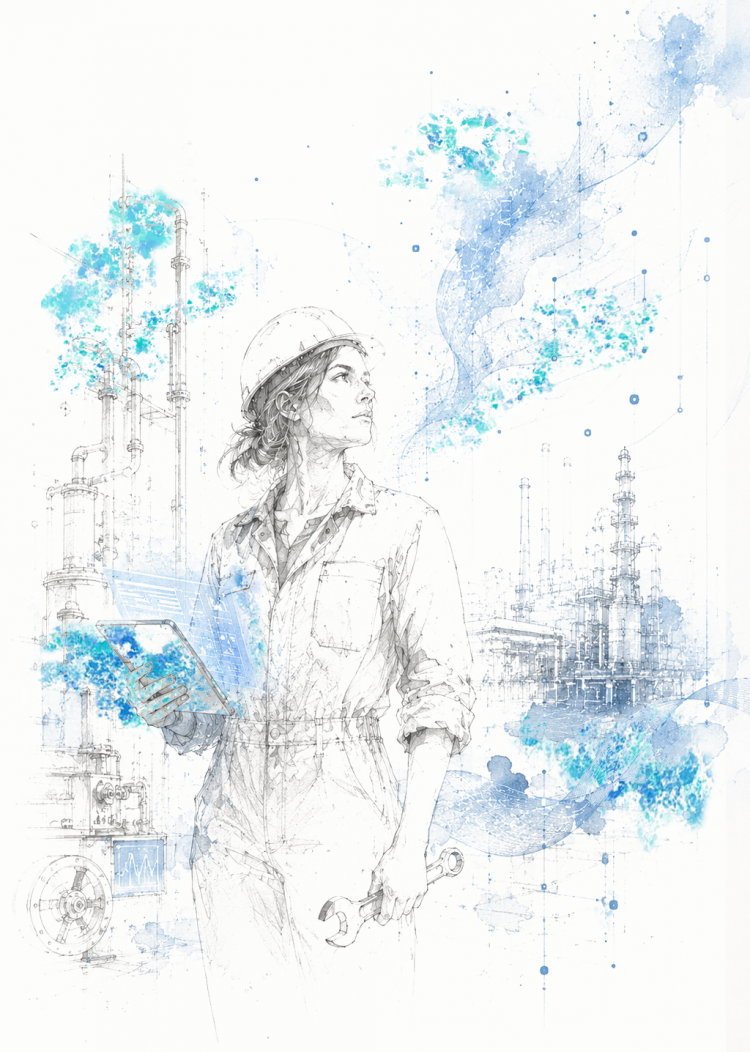
According to Davide Carneiro, the future of industry will depend less on technological sophistication and more on organisations’ ability to adapt. And that transformation has already begun.
Despite all technological progress, Pedro Senna believes the central theme of future industry will inevitably remain human. “The main pillar of Industry 5.0 is not sustainability or resilience. It is being human-centric – i.e., placing people at the centre of industrial decision-making.” Despite advances in industrial automation, it does not always make sense to replace people with robots. In many tasks, humans remain faster, more adaptable and more cost-efficient than fully automated systems. Therefore, the goal, the researchers emphasised, is not necessarily to eliminate human work, but to reorganise roles and create more balanced industrial environments in terms of efficiency, quality and operational safety.
At a time when industry faces high turnover rates and a shortage of skilled labour, many companies are using technology to reduce physical effort, repetitive tasks and more demanding working conditions. “We are still far from this reality, but I believe we will stop looking at dashboards and Excel sheets. We will simply ask the system what is happening, and it will respond,” stated Romão Santos. A future that may also include smarter energy systems, factories capable of managing their own energy, autonomous logistics and increasingly efficient operations. And it may accelerate further with emerging technologies such as quantum computing.
Across the 144 levels, few truly know why the Silo door was closed. Few ever dared to ask whether anything existed beyond those walls. For decades, many factories have simply tried to survive: keeping old systems running, adapting processes, avoiding shutdowns. Now, there is finally space to imagine something different. Are we finally ready to open the door?
 News, current topics, curiosities and so much more about INESC TEC and its community!
