


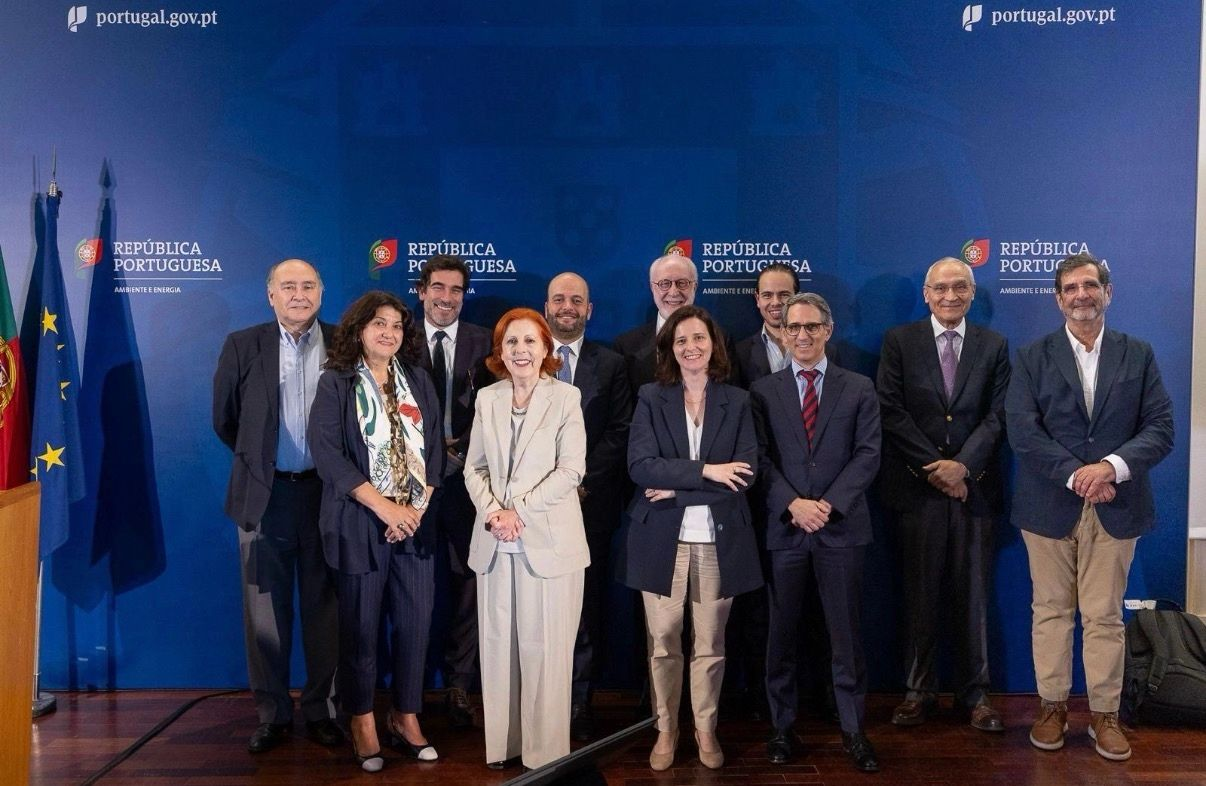
Clara Gouveia, member of INESC TEC’s Board, and João Peças Lopes, Director of the Institute, took part (at the invitation of the Ministry of Environment and Energy) in the Technical Advisory Group (GAT) created by the Portuguese Government to propose concrete measures to support the security and flexibility of the National Electricity System (SEN) in light of the sector’s ongoing evolution. The group’s conclusions were presented in late April 2026.
The GAT was established in May 2025 following the blackout that occurred on 28 April of that year. It brought together 10 independent experts with recognised expertise in electricity networks, regulation, energy planning and system technologies to produce the report that has now been made public. Over the course of almost a year, the group worked on concrete proposals for the National Electricity System, culminating in the public presentation of the final report to the Minister for Environment and Energy, Maria da Graça Carvalho, on 27 April 2026. The group’s work focused on five areas of analysis: governance and regulation; planning models; system architecture; generation requirements and grid components; digitalisation and monitoring; and market solutions and system services.
The security, resilience and flexibility of the SEN are a strategic priority for Portugal. Towards anticipating risks, identifying vulnerabilities and proposing measures, the Government sought technically grounded and independent recommendations to support decision-making regarding the future development of the national electricity system, ensuring security, reliability and resilience in the public interest.
Among the group’s main recommendations are the need to clarify sector governance and simplify the regulatory framework, redesign network planning as an adaptive process capable of dealing with uncertainty, and invest in critical components like energy storage, grid-forming converters, and dynamic voltage and frequency support. In the digital domain, the GAT recommends expanding real-time monitoring networks and developing a digital twin of the Iberian electricity system. Together with new analytical and decision-support features integrated into dispatch centres, these measures would improve the system’s ability to assess security conditions and define preventive and corrective actions in an increasingly dynamic and complex environment. Concerning the market, the report highlights the need for long-term contracting instruments and new system services suited to a low-inertia context.
According to João Peças Lopes, grid stability will increasingly become one of the most critical issues for the robustness of the electricity system.
“With the significant increase in electricity generation from renewable sources and given the expansion of the power grid to meet growing electrification and connections to generation centres, system stability challenges will become especially critical for operation. This implies stronger investment in heavy hardware solutions within the grid, enhanced dynamic security monitoring capabilities, and the deployment of new advanced system services,” the researcher said.
Digitalisation is now a central element in ensuring the security and resilience of the national electricity system, as explained by Clara Gouveia. “When we speak of digitalisation, we refer first and foremost to the ability to monitor the system in real time, supported by analytical applications that continuously assess network security and stability, as well as new tools that support decision-making and the timely identification of the most appropriate control actions. However, greater observability also requires further progress, particularly in data interoperability. It is essential to facilitate efficient information sharing between the different actors in the system and across control areas, ensuring consistency, quality and speed of access to data. This will help enable new services and the active participation of flexible resources,” concluded the INESC TEC Board member, who was part of the GAT.
INESC TEC’s participation in this group reflects the complementarity between the research carried out at the Institute and the needs of public policy in the energy sector – one of the strategic areas in which INESC TEC has been consolidating a position of national and international leadership. The work developed by INESC TEC over more than 40 years in the field of Power & Energy Systems provides precisely the knowledge base that underpins recommendations of this kind, demonstrating how applied science can (and should) inform decisions with systemic impact.
It is worth recalling that, following the blackout, INESC TEC produced the position paper Retrospetiva e Lições de um Apagão, as well as several science communication pieces through the INESC TECWatch series, helping civil society better understand what happened in the Iberian Peninsula on 28 April 2025.
 News, current topics, curiosities and so much more about INESC TEC and its community!
