


It’s one of the Mobilising Agendas under Portugal’s Recovery and Resilience Plan (PRR) and is helping to create a model for the Factory of the Future. If you’ve already read about DRIVOLUTION, you’ll know that it goes far beyond developing an Autonomous Aerial Vehicle designed to carry out logistics operations in industrial warehouses; let’s take a closer look.
The Drivolution Agenda focuses on the automotive industry, bringing together a range of actions aimed at developing new products, processes and services (PPS).
At the EDA – Estofagem de Assentos factory (a FORVIA subsidiary and manufacturing facility in Nelas), another solution is currently being tested as part of this ambition.
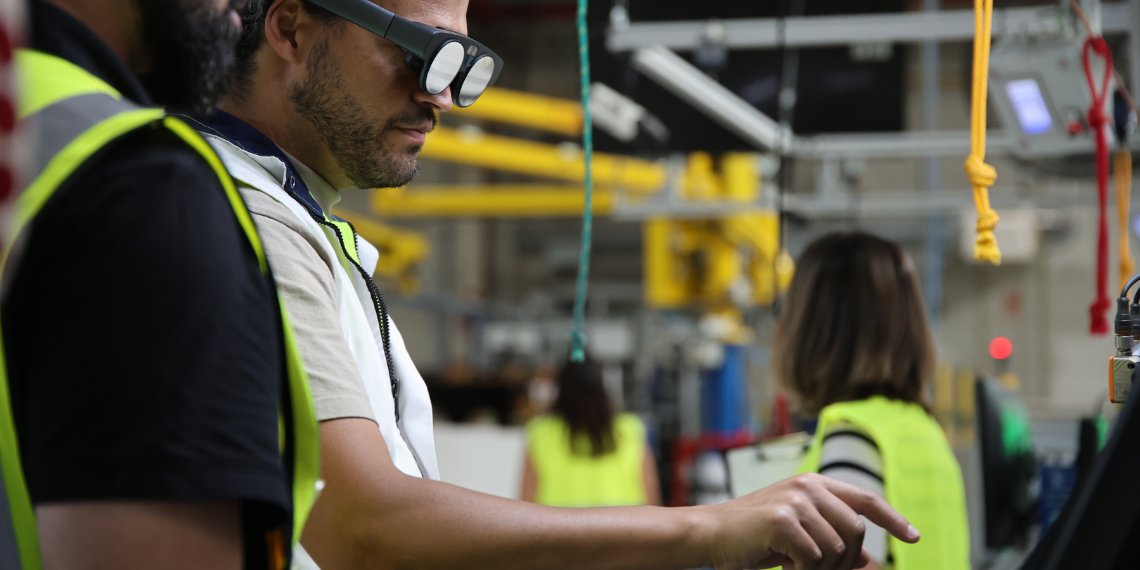
“KIT-AR is an industrial augmented reality solution that supports operators on the shop floor by providing step-by-step instructions tailored to the task they are carrying out,” explained Manuel Oliveira, CEO of SkillAugment, the company responsible for developing the software solution. “It uses augmented reality glasses to support the final quality inspection of both car seat backs and seat cushions,” added Roberto Pinheiro, process engineer at the Nelas plant.
The solution was designed to address a real-world challenge: “Some quality defects only become apparent when the product reaches the end customer, even though they may have originated in the factory because the operator didn’t carry out the inspection correctly,” he continued.
As a multinational company specialising in automotive seating and strongly committed to digitalisation, joining the project was a natural step, according to Rui Sousa, production director at FORVIA’s Nelas plant. “We seek to facilitate operators’ work by helping them inspect these critical points more effectively, improving the quality of our seats and reducing – or ideally eliminating – any customer complaints.”
But how does the solution work in practice? Manuel Oliveira explained that the software’s main innovation lies in the quality and dynamic generation of instructions adapted to the current context. “Depending on the product at the workstation, the instructions are created dynamically based on what the operator needs to do, which tools they need to use and, in this particular case, the visual inspection they need to perform.”
The operator wears a pair of augmented reality glasses and “can see everything around them while receiving prompts telling them to look at a specific point, collect material from a particular location or consult the relevant technical drawing. They then complete checks to confirm that the task has been finished or to report any issues identified.”
At the end of the process, everything is digitally recorded. Operators no longer need to complete paper documentation or use a separate terminal, while the solution also supports continuous process improvement by providing a digital tool for lean manufacturing.
https://www.youtube.com/watch?v=Sokkx1JrHxM
INESC TEC evaluated the solution in a real environment
Within this context, INESC TEC worked closely with SkillAugment on research and technological development activities, including defining and specifying the pilot use cases and the solution itself, followed by evaluating the solution in a real industrial environment.
“INESC TEC’s role is largely about identifying the main barriers and challenges to implementing these solutions so that we can improve the adoption process for these technologies,” explained Ana Simões – who, together with Filipa Ramalho, is part of the INESC TEC research team working on the project.
The validation process carried out by INESC TEC included field observations conducted both before and after implementation. During the first stage, the team identified the ergonomic, cognitive and operational challenges experienced by operators. Afterwards, they analysed how operators adapt to the augmented reality glasses and adjust their work to the new tool, recording any new challenges encountered.
“In this project, we’re studying the adoption of human-centred augmented reality technologies on the shop floor,” said Filipa Ramalho. She believes this is particularly important “not only because we’re addressing organisational adoption, but also because we’re analysing said adoption from the operator’s perspective.”
This assessment was complemented by interviews, during which operators compared the new solution with the one they previously used, highlighting both advantages and potential improvements. The data gathered through observations and operator feedback enables the solution to be progressively refined, making it better suited to the realities of the factory environment and the people who use it every day.
Ana Simões is confident about the impact these technologies can have on the automotive industry, highlighting not only “improvements in product quality”, but also “better quality of life for operators in their workplace”. Ultimately, as Filipa Ramalho stated, “we want technology to support an industry that is more efficient, more competitive and, above all, more human-centred.”
 News, current topics, curiosities and so much more about INESC TEC and its community!
