


Reducing the price of food nearing the expiry date can prevent it from ending up in the bin. But where should these products be placed in a supermarket? On the usual shelf or in a dedicated discount area? And what happens when consumers know they may find the same products at even lower prices on a surplus food platform at the end of the day?
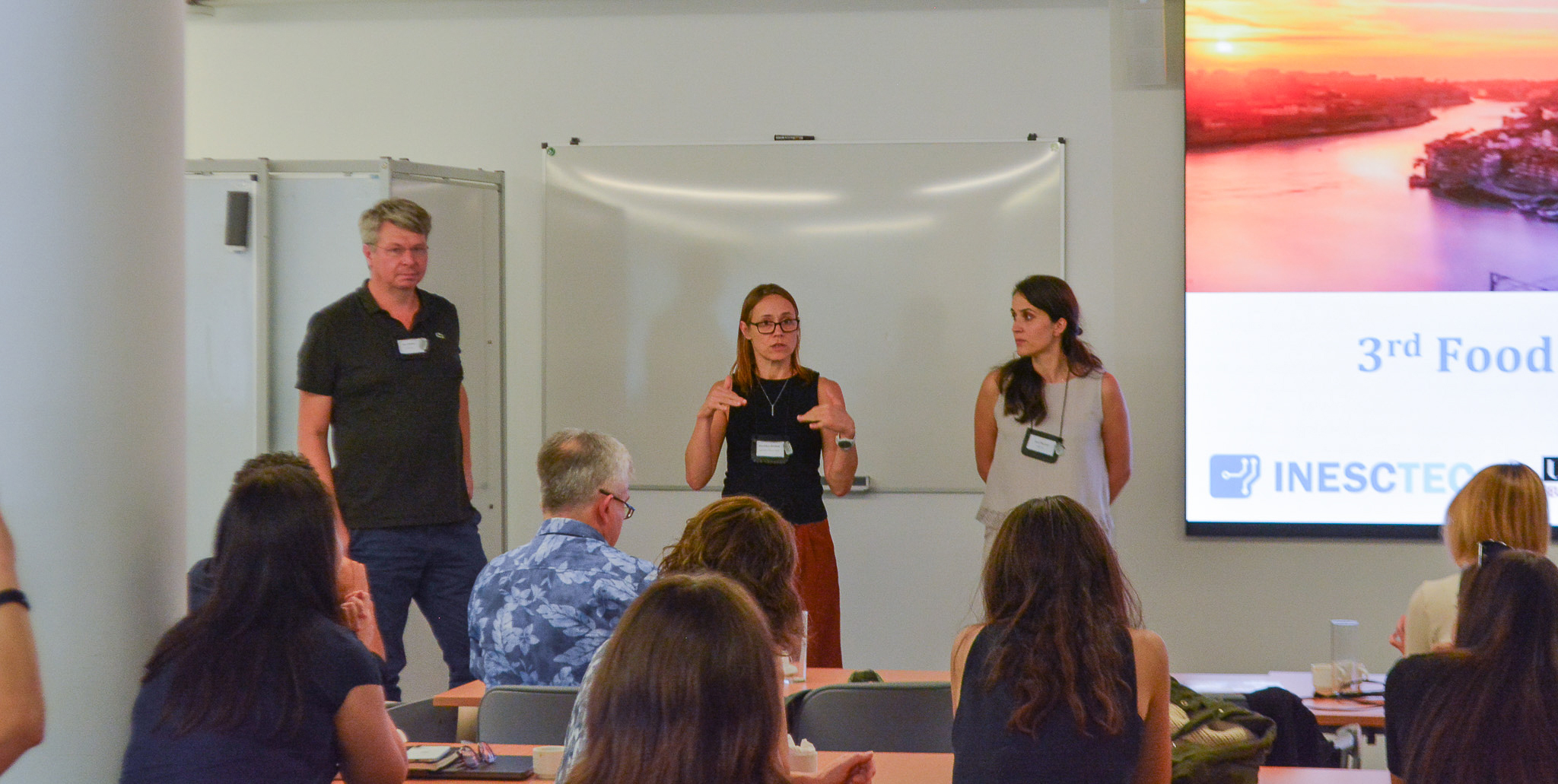
Decisions like these can determine whether food is sold, donated or wasted. Researchers from several international institutions gathered in Porto from 20 to 22 September for the third edition of the Food Waste Workshop, co-organised by INESC TEC and the Faculty of Engineering of the University of Porto (FEUP).
Over three days, discussions covered pricing and discounts, inventory management, consumer behaviour, food donations, expiry dates, food waste prevention platforms, packaging and logistics.
These issues raise a broader question: how can data, mathematical models and decision-support tools help stakeholders across the food supply chain reduce waste while taking consumer choices and companies’ logistical and economic needs into account?
“The workshop showed that there is a highly engaged community working on food waste, but also one that approaches the problem in many ways. This combination led to very effective discussions and opened the door to new ideas and potential collaborations between researchers and professionals”, explained Sara Martins, researcher at INESC TEC.
Concerning INESC TEC, responsible for co-organising the event with FEUP, the issue extends well beyond the workshop itself. Food waste reduction has been an ongoing research focus. Sara Martins was also involved in the BeFresh project, in which INESC TEC examined another factor affecting food waste: MLOR (Minimum Life on Receipt), a criterion used to define the minimum remaining shelf life a product must have when it is received by a retailer.
The research examined how greater flexibility in this criterion could help reduce waste across the supply chain without compromising other requirements for food marketing. Shortly after the Porto workshop, the PhD thesis of INESC TEC researcher Mariana Sousa, developed as part of BeFresh, received an award at the EWG Retail Operations Annual Meeting, held in Lisbon: an event dedicated to exploring the challenges faced by the retail sector.
Back in Porto, Sara Martins presented the paper An Analytical Model for Display Strategies in Perishable Retail. As co-author, she explored how the placement of discounted perishable products can affect both sales and food waste.
Each display strategy influences how easily consumers find these products, whether they make impulse purchases and whether they choose a discounted item instead of a full-price alternative.
“The study shows that there is no single display strategy that maximises profit in every context. Furthermore, the strategy that minimises food waste does not always coincide with the one that maximises profit, highlighting the importance of taking different objectives and operational characteristics into account when making decisions,” the researcher concluded.
This was the third edition of the workshop; the first was organised by the Technical University of Munich in 2024, before the event moved to the University of Massachusetts Amherst in the U.S.A., back in 2025. Bringing together industry professionals and researchers, the Porto edition welcomed 42 experts to further the debate on food waste in food systems.
 News, current topics, curiosities and so much more about INESC TEC and its community!

