


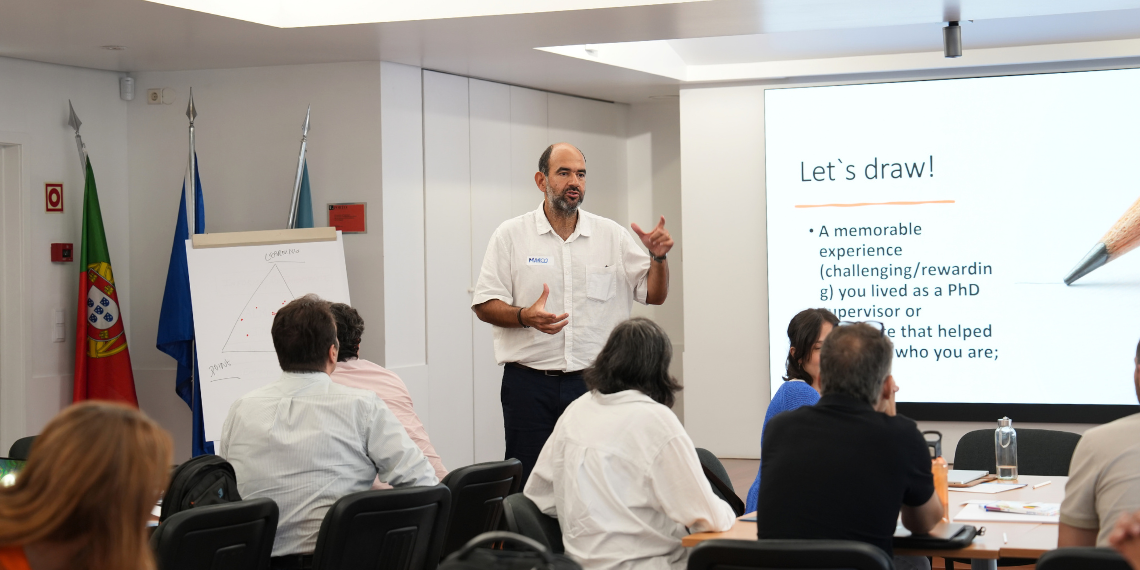
How can a PhD researcher be supported without limiting their autonomy? How can supervision be adapted to different people, stages and contexts? And what role do communication, culture and supervisors’ own experiences play in this relationship? These were some of the questions at the heart of The Art of PhD Supervision – Practical conversations on doctoral supervision: roles, relationships and challenges, an initiative promoted by INESC TEC that brought together supervisors from different fields and with varying levels of experience in a practical and collaborative environment. Throughout the day, participants reflected on their own practice and, through conversations with peers, discussed the real challenges of supervision. The workshop was led by Marco António Carvalho Filho, Professor of Health Professions Education Research and Programme Leader of LEARN at University Medical Center Groningen (UMCG).
A shared responsibility
The starting point was precisely a broader view of supervision: the “PhD experience” does not depend solely on the relationship between supervisor and researcher, but also on the conditions created by the institution to support said relationship and foster the development of supervisors themselves. The initiative sought to provide a less “lecture-based” and more participatory space, where real challenges could be discussed, participants could learn from their peers’ experiences and future needs could be identified.
Much more than overseeing research
Organised into four interactive blocks combining introductory activities, individual reflection, practical exercises and peer discussion, the workshop explored different dimensions of supervision practice: the educational purpose of doctoral supervision and the development of the PhD researcher as a researcher; different supervision styles and the need to adapt them throughout the doctoral journey; the influence of culture on communication and expectations; and, finally, the values, experiences and beliefs that shape supervisors’ professional identities.
One of the ideas that stood out most during the event was that supervision goes “far beyond overseeing the research project”: it can contribute to knowledge and skills’ improvement, integration into a scientific community and, above all, enabling PhD researchers to become autonomous and critical researchers capable of developing their own professional identities. As participants shared their experiences, it became clear that, for them, students’ development is one of the most rewarding aspects of supervision. Supervisors highlighted the “satisfaction and fulfilment” that comes from witnessing the “development and growth of students”, seeing them obtain autonomy and confidence, helping them while simultaneously learning from them. This process often leads to partnership opportunities, mutual learning and shared growth.
Relationships: one of the most complex challenges
An analysis of this journey – with ups and downs – would not be complete without reflecting on the main difficulties supervisors mention, with the “management of the supervision relationship itself” standing out clearly. This broad concept encompasses issues such as lack of time, deadlines and procrastination, bureaucracy, withdrawals, difficulties in providing negative feedback, and dealing with mental health issues or personal problems. Another challenge is finding the “right balance between supporting and giving autonomy, between applying pressure and giving space, and between guiding and avoiding micromanagement”. Managing and clarifying expectations also emerged as particularly important issues.
There is no single way to supervise
According to these questions, the discussion moved on to different supervision styles: functional, enculturation, critical thinking, emancipation and relationship development. Although these do not constitute fixed categories, they provide a repertoire that supervisors can draw on depending on the researcher, the stage of the PhD and the situation. Participants’ reflections highlighted the need to continually adjust the balance between structure and autonomy and between “feedback and reassurance”, making supervision a more conscious and intentional practice.
In a process in which personal factors can influence the success of the task undertaken by the researcher, the importance of culture cannot be overlooked. This applies not only to nationality, but also to professional, disciplinary and institutional cultures, as well as individual experiences. All these factors are reflected in communication (whether more direct or indirect), the degree of support provided, the way feedback is provided, hierarchical and authority relationships, the building of trust and decision-making processes. Rather than learning “rules” about different cultures, the discussion pointed to the importance of curiosity, openness, self-awareness and cultural discretion, as well as making expectations explicit and seeking to understand the other person’s context.
Finally, the event also highlighted that “being a supervisor also means reflecting on who we are as supervisors”. Through a series of exercises, participants explored dimensions of supervision that are not always easy to put into words, as they involve values, emotions, assumptions, tensions, relationships and significant experiences. The exercise reinforced the idea that supervision is not merely a set of techniques, but rather a practice shaped by each supervisor’s experiences, values and beliefs.
A space supervisors want to continue having
Feedback collected after the workshop reinforced the relevance of the initiative and the value of this type of space. The average rating for the usefulness of the initiative to supervision practice was 4.8 out of 5; all respondents gave it a rating of 4 or 5, and 81% expressed an interest in future initiatives.
Among the topics participants would like to explore further were difficult conversations, student autonomy, conflict management, and mental health and wellbeing. The possibility of creating a community of good practices was the most selected format for future initiatives, alongside interest in shorter thematic sessions, discussion of specific cases and further opportunities for peer reflection.
“One of the strongest ideas to emerge from this workshop is that supervising a PhD goes far beyond overseeing research or results. It means helping each doctoral researcher become an autonomous researcher, adapting supervision to their needs, the stage of their journey and the context. It was equally important to create a space where supervisors themselves could pause, reflect on their practice and learn from one another,” highlighted Sara Brandão, who was responsible for promoting the initiative.
The feedback collected reinforced the interest in continuing to provide these types of spaces, favouring practical, participatory formats based on peer learning and discussion of real challenges in doctoral supervision. The challenge now is to build on this learning and continue creating opportunities to bring to light issues that are part of everyday supervision, but for which there is not always space for collective reflection.
 News, current topics, curiosities and so much more about INESC TEC and its community!
