


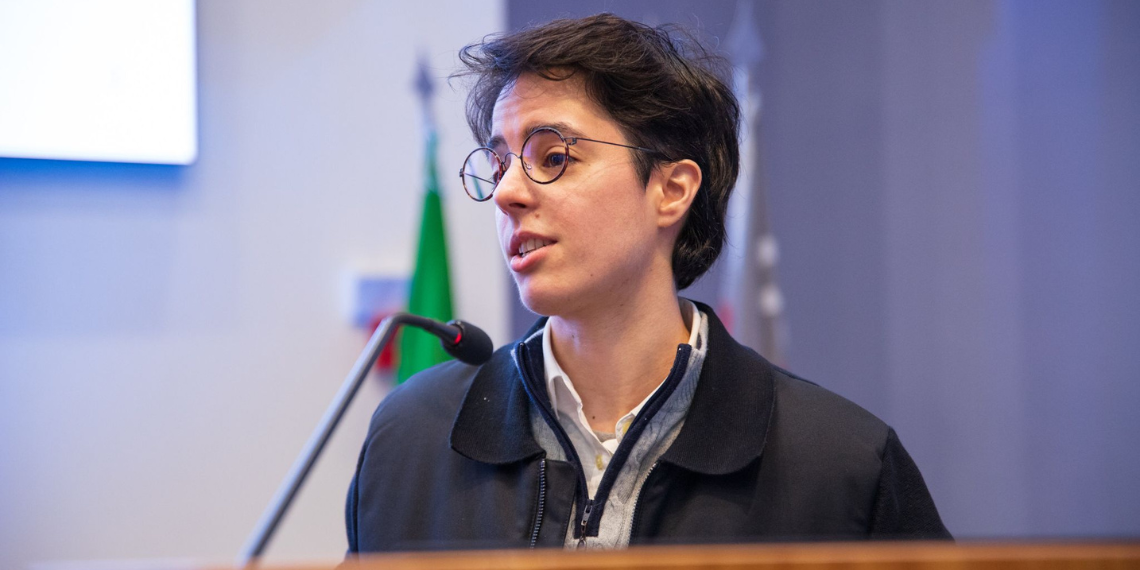
The 2025 edition of the Forum on Digital Ethics in Research – Beyond Compliance, organised within the scope of ERCIM, will be a particularly memorable occasion for Miriam Seoane Santos. In addition to receiving the ERCIM Cor Baayen Award, announced a few weeks earlier, the INESC TEC researcher took part as a speaker in the session Data altruism and open resources, which sparked wide-ranging reflections on the role of Artificial Intelligence (AI) in everyday life.
Miriam Seoane Santos’ interest in the data used to train AI models dates to her first degree in Biomedical Engineering; since then, she has focused her research on identifying and analysing quality issues in the data that “feeds” AI systems. These issues may stem from the inherent characteristics of specific data domains, but also from factors like deliberate design choices, human error, software or hardware failures, or operational constraints.
However, when working with generated accessible data, researchers like Miriam have little choice but to adopt a critical stance: acknowledging imperfections, mitigating their effects, and carefully interpreting results.
That’s why it’s crucial to step back and examine the upstream stages of data generation and collection – perceiving them as valuable processes in their own right, rather than merely a preliminary step in AI development, since early, poorly informed decisions can shape the entire research lifecycle. This was the core message of her talk at the ERCIM Forum Beyond Compliance, held in Rennes, France, entitled Responsible by design: building trust in open and shared data. “I tried to encourage the audience to think of data generation as a process that must be transparent, explainable, collaborative, auditable, and clearly transmitted to all those who may be affected by an AI solution,” mentioned the researcher.
While software-sharing standards are now well established, the rules governing data sharing remain relatively vague. In research contexts, data is often approached from a largely utilitarian perspective, with emphasis placed on practical aspects such as licensing, formats, access conditions, and basic documentation of structure or volume. Miriam pointed to Labeled Faces in the Wild, a widely used benchmark dataset for training computer vision models, which was later shown to produce discriminatory outcomes, particularly for women and people with darker skin tones. “The dataset was publicly available, but it was not representative. It was ‘open’, but not ‘trustworthy’ – at least for certain applications,” she stated.
For this reason, all actors involved in data generation, collection, and use share a heightened responsibility: “to perceive data as a social object and to contextualise it as much as possible.” This includes documenting where data comes from, why it was collected, the assumptions behind it and intended use, as well as all limitations. Equally important is the ability to communicate and document these choices clearly, both for all stakeholders and for the broader community in which the system will ultimately be deployed.
Miriam’s participation in ERCIM events, where she also received the 2025 Cor Baayen Award, got very positive feedback. “I was genuinely challenged by the discussions,” she said. “What struck me most was realising that experts from very different fields share similar concerns, yet there are no ‘right answers’. Even in relatively simple exercises, opinions diverged widely – some more cautious, others bolder, all with more questions than answers.”
The experience left a lasting impression across different aspects of her life. On a personal level, it prompted “deeper reflection on the societal challenges posed by AI, including issues like free will, responsibility, cognitive dependency, and civic engagement”. As a lecturer, it reinforced her “sense of responsibility to counterbalance certain effects of AI use in education”. And as a researcher, it “reaffirmed her belief that even small contributions can help advance AI literacy and foster more informed public debate”.
Digital literacy as a foundation for ethical AI
Miriam Santos’ work towards more responsible AI is closely tied to her efforts to promote digital ethics. At the heart of this endeavour, she argued, lies literacy. The AI era demands professionals with comprehensive skill sets.
“We need regulation, which means legal professionals must be equipped to understand technical concepts and limitations. We need educational reform, so that AI is integrated in ways that genuinely benefit students – future professionals in many fields. And we need to balance innovation with responsibility and sustainability.”
Motivated by her participation in ERCIM and aware of the existing gaps in tailored educational resources, Miriam recently launched the platform Practical Responsible AI; the goal is to broaden access to education on AI-related topics. At this stage, the materials are being used in the Artificial Intelligence and Society course of the master’s programmes in Artificial Intelligence at the Faculty of Sciences (FCUP) and the Faculty of Engineering (FEUP) of the University of Porto. The objective, according to Miriam, is to enable AI professionals to learn more about areas outside their core expertise (both technical and legal), while also supporting professionals from other fields who wish to explore the foundations of Responsible AI and reflect on how these concepts intersect with their own area. The platform also provides resources that can be used in workshops and multidisciplinary training sessions, such as the one Miriam delivered at the ERCIM Forum Beyond Compliance 2025.
The researcher mentioned in this news piece is associated with INESC TEC and the Faculty of Sciences of the University of Porto
 News, current topics, curiosities and so much more about INESC TEC and its community!
