


Accessibility. Diversity. Inclusion. In the 21st century, these terms feature in conversations, debates and social media feeds more than ever before. Concerns around difference are voiced more openly, opinions are more visible, and the challenges faced by people living with disabilities or other forms of difference are finally being recognised as a responsibility shared by society.
At INESC TEC, the Diversity and Inclusion Committee has long encouraged the community to look at everyday life within the institution through a more inclusive lens by giving visibility to lived experiences, identifying inequalities and promoting measures that foster accessibility and equal opportunities.
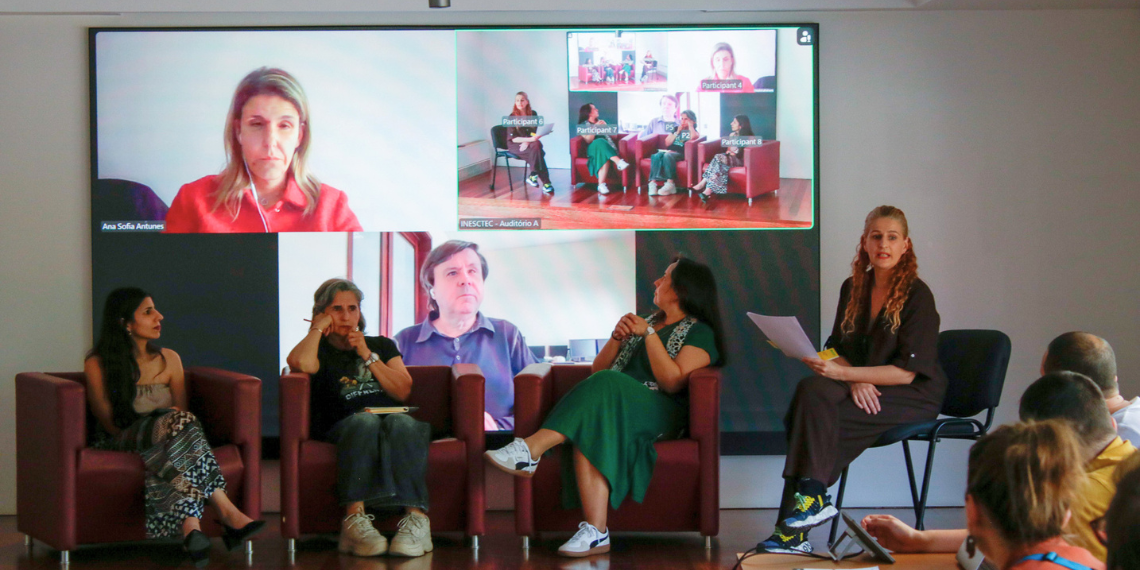
In this sense, INESC TEC joined the international Global Accessibility Awareness Day (GAAD) 2026 initiative by organising the event Dia Global de Sensibilização para a Acessibilidade – Vivenciar a Acessibilidade, Sensibilização, Barreiras e Inclusão na Prática. Throughout the afternoon, participants explored common accessibility barriers through interactive workstations and joined discussions with experts in accessibility, inclusive design, assistive technologies and inclusion.
Tânia Rocha, INESC TEC researcher and member of the Diversity and Inclusion Committee, believes it’s essential to keep accessibility at the centre of public discussion. She stressed that existing barriers are not confined to one specific group of people. For this reason, she argued, it is just as important to raise awareness by allowing people to experience both physical and digital barriers first-hand.
But what happens when speakers such as Ana Sofia Antunes, former Portuguese Secretary of State for the Inclusion of People with Disabilities and Member of Parliament; Lia Ferreira, former Member of the Portuguese Parliament, architect and researcher specialising in accessibility and inclusion; Maria van Zeller, INESC TEC researcher; Alice Ribeiro, member of the Inclusion Support Unit (NAI) at the University of Porto; and Andreia Matos, founder of Adapt4You, come together to discuss these issues?
According to Tânia Rocha, the result was “the sharing of perspectives, experiences and the barriers people encounter in different everyday contexts.”
According to Alice Ribeiro, the issue is straightforward: embracing difference requires effort, and “effort is something we naturally resist.” She explained: “It requires me to stop, to look at the other person, to truly listen, to try to understand beyond my own perspective and recognise what the other person is saying and how they prefer to engage.”
She stated that there’s still “enormous resistance to this open and diverse world.” “We tend to focus much more on the effort involved than on the benefits of living in a diverse society that has the potential to help us grow in remarkable ways,” she added.
When it comes to developing accessible technology, INESC TEC researcher Maria van Zeller was unequivocal. “We’re all talking about Artificial Intelligence and AI agents, but how are we designing these agents with the people who will use them? Are we really doing what we should be doing? Are we including people with specific needs in the loop, or are we only designing for those without them?”
For the researcher, this is far more than a minor detail. She is convinced that technology can only become “a tool for inclusion if we include those people throughout the development process.” The conclusion is clear: “Designing technology without involving all types of users is a mistake, and the result is that it simply won’t work.”
But when we talk about technology and accessibility, what exactly do we mean? The answer is more complex than it may first appear. Developing these kinds of solutions is precisely where Andreia Matos’s work fits in. From an early stage, she recognised the importance of creating tailored solutions because “every person with a disability is unique and has very different characteristics.”
She also pointed to how much has changed. “In the past, when someone acquired a disability through an accident or illness, they often felt that life had come to an end. They believed they would no longer be able to go to certain places, use everyday objects, continue studying or remain in employment.” Today, she said enthusiastically, that is no longer necessarily the case. “Thanks to new technologies and new resources, we are now able to give people with accessibility challenges far greater independence and opportunity.”
The conclusion is becoming increasingly clear. “It’s not the end,” she said. “It’s the beginning of learning to live a new life with new resources.”
 News, current topics, curiosities and so much more about INESC TEC and its community!
