


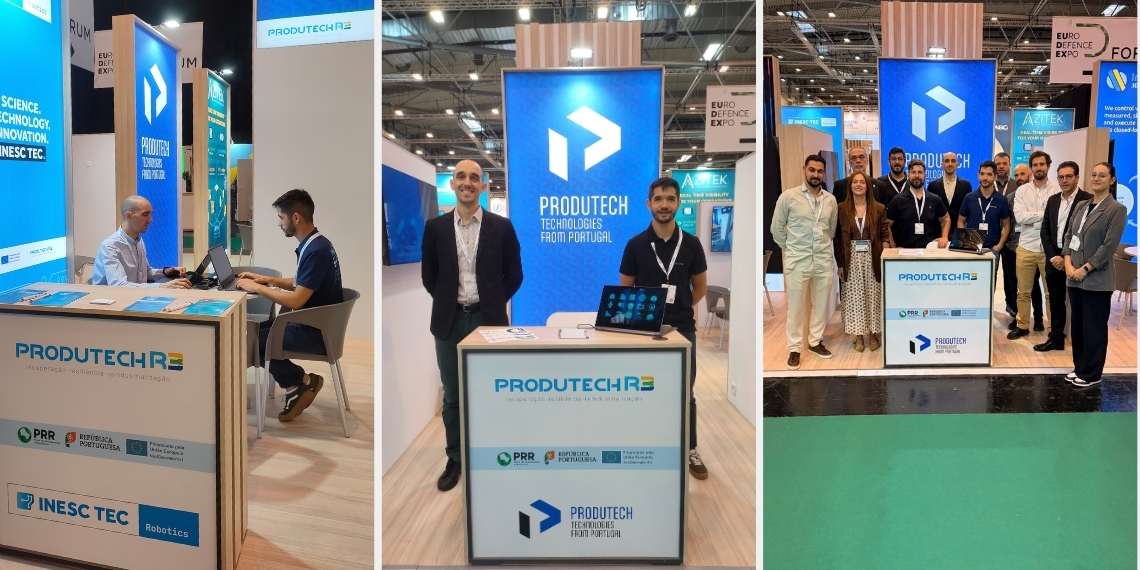
The first edition of Europe Defence Expo brought together companies, research institutes, government bodies and key stakeholders to define the sector’s next steps – and INESC TEC was there to showcase how it can help transfer technologies to industry.
The key players shaping the future of the European defence sector gathered in Germany for the Euro Defence Expo (EUDEX). INESC TEC was there too, attending the event, which brought together, over four days, demonstrations and discussions on how talent, technology and the industrial sector can propel Europe forward in this strategic sector.
Researchers Roberto Magalhães Silva and Luís Santos represented INESC TEC in Essen, showcasing the Institute’s expertise (it will coordinate the largest project with Portugal’s participation funded by the European Defence Fund) while also identifying collaboration opportunities through contacts with companies, systems integrators, research and technology institutes, and government bodies. Moreover, the researchers also had the opportunity to visit Security Essen, a leading international trade fair dedicated to security, surveillance and infrastructure protection, complementing the technology scouting carried out at EUDEX and expanding their network of contacts in areas such as autonomous robotics, surveillance systems and integrated security platforms.
“Besides showcasing the work carried out by INESC TEC, we have been exploring ways of establishing stronger European partnerships in robotics, autonomy and dual-use technologies,” summarised Roberto Magalhães Silva.
As part of the delegation of PRODUTECH – Production Technologies Cluster in Portugal, INESC TEC also showcased the work developed under the R3 Agenda.
The participation also placed a strong focus on autonomous robotics for terrestrial outdoor environments, an area presented by researcher Luís Santos. Potential partners showed particular interest in the robotic platforms developed and manufactured by the institution, whose application in agriculture, forestry, civil protection and defence scenarios has been validated in a range of real-world settings.
“The ability to develop complete robotic systems in-house, from hardware to autonomy and intelligence, was frequently highlighted as a differentiating factor and one offering significant added value, particularly in a sector where technological autonomy, adaptability and speed of development are critical factors,” added Roberto Magalhães Silva.
Keyword: complementarity
According to the researcher, the word that defined the experience at this first edition of the event was “complementarity”. “It was particularly interesting to identify organisations with highly complementary strengths, from robotics manufacturers and security platform providers to developers and innovation-driven SMEs looking to accelerate the maturity and adoption of their technologies,” he said.
From 22 to 25 September, EUDEX provided a platform for exchanging ideas on humanoid and semi-humanoid robotic platforms, advanced mobility solutions for difficult terrain, human-robot teamwork and autonomous operations, as well as, among many other topics, how to bridge the gap between research and industry.
The presence at the trade fair also made it possible to identify new technology partners, suppliers and manufacturers capable of contributing to the development of INESC TEC’s robotic platforms. “These interactions opened the door to future collaborations that could strengthen INESC TEC’s in-house capabilities and accelerate the development of high-performance robotic solutions for applications in defence, security and civil protection,” the researcher said.
As an RTO (Research and Technology Organisations), INESC TEC’s role, he recalled, “is not to compete with industry, but rather to help create the next generation of technologies, validate them in real-world environments and transfer them to companies capable of scaling them up and bringing them to market”.
With the stay in Germany now over, it is time to “turn conversations into collaborations” and shape opportunities “for a sector that is becoming increasingly important to Europe’s future resilience and strategic autonomy”, Roberto Magalhães Silva concluded.
 News, current topics, curiosities and so much more about INESC TEC and its community!
