


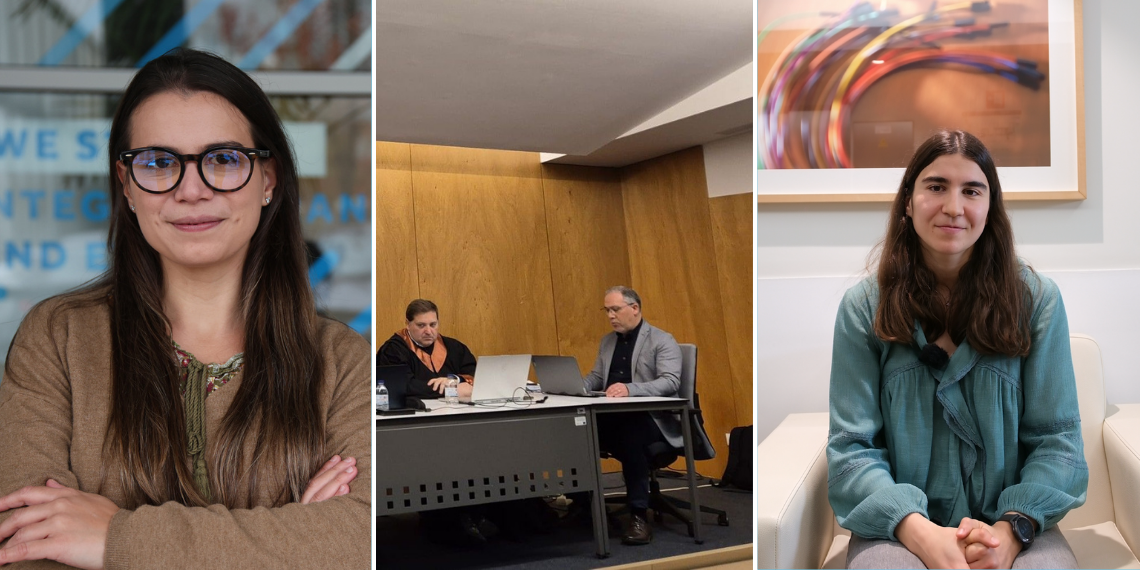
The number of INESC TEC researchers holding a PhD has increased once again, following new theses in the fields of industrial engineering and management, and informatics. Focused on digital transformation in local public administration, consumer behaviour, and innovation management in contexts of related diversification, these research projects reinforce the applicability of academic work to industry and the impact on citizens’ daily lives, particularly in shaping public policy.
Digital transformation of local public administration – the importance of literacy and a tailored approach
The COVID-19 pandemic marked a turning point in the digital transformation of public administration. A process that was already underway was accelerated by the social dynamics of that period – with local services being no exception. However, there are several factors to consider beyond the technological dimension: the human factor is often undervalued, in favour of investment in systems, platforms and digital tools.
In his thesis, José Arnaud addresses the challenges surrounding employees’ digital literacy, particularly in terms of skills, attitudes and confidence in using technology. “The literature addressed digital transformation and digital literacy, but often separately, without a model clearly explaining how these two phenomena relate in the specific context of local public administration,” said the INESC TEC researcher. He identified this gap as an opportunity for his PhD in Web Science and Technology at the University of Trás-os-Montes and Alto Douro (UTAD).
Within this framework, an explanatory model was developed to better understand how the digital literacy of local public administration staff can either enable or limit digital transformation processes. In said processes, the “heterogeneity” of local public administration proved to be “one of the main challenges”, since “each municipality and each service have very different levels of digital maturity, available resources and organisational culture”. These nuances made data collection “more complex, requiring careful methodological work to ensure that the explanatory model was robust and generalisable, without losing sensitivity to local specificities”.
Another aspect that required particular attention, according to José Arnaud, was the operationalisation of the concepts of “digital transformation” and “digital literacy” – two “broad terms, used in different ways in both literature and practice”. The researcher had to “define clear indicators, develop appropriate data collection instruments and validate these measures to ensure scientific thoroughness”.
“The desire to produce knowledge with practical value for policymakers and those responsible for administrative modernisation was a decisive factor in choosing this topic,” he stated. He mentioned that the focus on the “central role of people and their skills” was particularly relevant for “defining public policies, designing training programmes and strategic planning in local public administration”. “By demonstrating that digital literacy is not an accessory element but a structural factor in digital transformation, the study contributes to a more integrated and realistic approach to administrative modernisation,” José Arnaud concluded.
Reducing food waste through the study of consumer behaviour
After focusing her Master’s research on consumer behaviour and willingness to pay for perishable products throughout their shelf life, Mariana Silva Sousa decided to explore this topic further in her PhD in Industrial Engineering and Management. Her motivation stemmed from an “interest in understanding how knowledge of consumer behaviour could be applied to improve the management of these types of products”. According to the INESC TEC researcher, her thesis “aims to develop methods that enable retailers to manage perishable goods more efficiently, studying both dynamic pricing adjustments and the definition of product assortments available for sale”.
Efficient product management is an increasingly relevant issue, with both economic and environmental implications. Moreover, losses from expired products that are never sold represent significant costs for retailers; besides this, they continue to contribute to rising levels of food waste. With the growing availability of data and increased computational capacity, retailers now have better tools to support complex decision-making, opening new opportunities for research based on quantitative methods and empirical data. “This type of approach has been gaining prominence in academic research and is attracting increasing interest among retailers,” the researcher explained.
Throughout the research, Mariana Silva Sousa explored approaches that combine “demand models with reinforcement learning methods, enabling the analysis and optimisation of pricing strategies over time”. At the same time, “assortment optimisation was analysed alongside these variables, seeking to understand how supply decisions and pricing can be more effectively aligned”. Mariana Silva Sousa hopes that this work will contribute to the “development of more realistic models for managing perishable products and serve as a foundation for future research that integrates even more operational and behavioural data”.
Innovation management in contexts of related diversification
Marcella Mendes’s PhD research in Industrial Engineering and Management also builds on previous work, particularly in innovation and technology management during her Master’s studies and professional experience. This time, the challenge was proposed by EFACEC and focused on innovation management in contexts of related diversification – an environment that combines multiple opportunities and challenges due to the presence of several business units sharing resources and knowledge. The exploration of internal synergies enabled by this context, alongside strong interdependencies, formed the starting point of the research.
“As this work brings together theory (academia) and practice (industry) in a very direct way, one of the main challenges was maintaining effective balance between the two,” the INESC TEC researcher recalled. Achieving this required “a deep understanding of the company’s practical needs, without compromising the methodological accuracy and scientific robustness required in academic work”.
According to Marcella Mendes, developing research skills was “essential” to “understand and address the demands of R&D and innovation management in a structured and sustainable way”. At a time when these areas face “significant challenges across different sectors and contexts”, a better understanding of how these processes operate in complex environments such as related diversification is not only highly relevant but also valuable for advancing innovation management, by generating “insights that are applicable to other contexts with similar levels of complexity”.
Among the findings, Marcella Mendes highlighted the understanding and systematisation, at a micro level, of how R&D and innovation mechanisms operate in environments of strong internal collaboration (mechanisms that are “influenced by specific attributes of the organisational environment”). Additionally, the research enabled the validation of a methodology to measure and monitor innovation performance across different business units. “The expectation is that these contributions will support future academic and practical work, particularly in developing innovation management systems better suited to complex organisational contexts,” she concluded.
 News, current topics, curiosities and so much more about INESC TEC and its community!
