


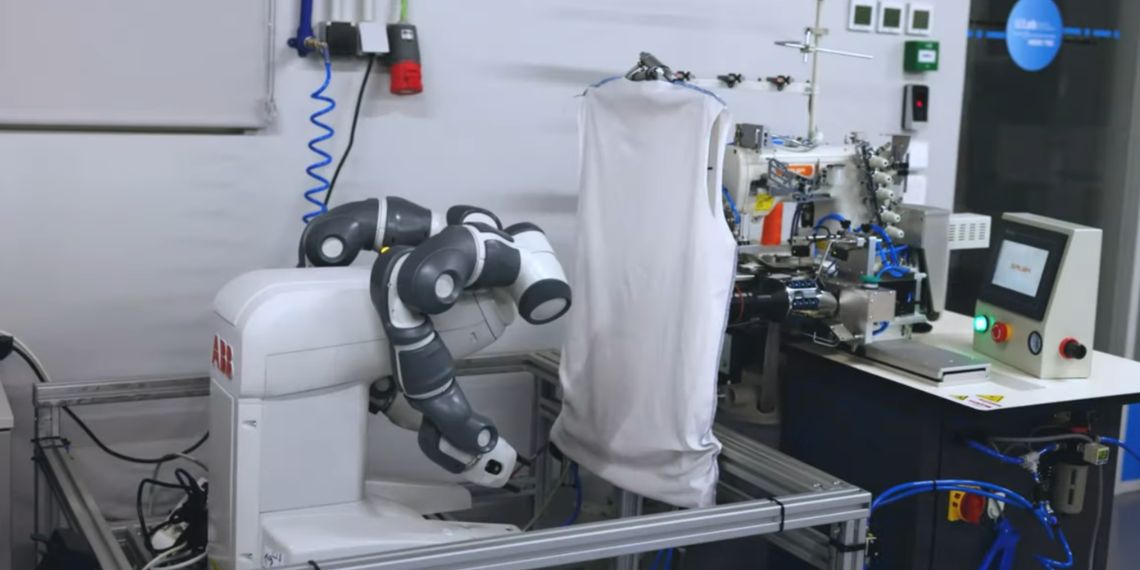
Did you know that INESC TEC is developing a solution to make automated fabric handling possible? The paper Clothing Simulation in MuJoCo with the Evaluation of the Sim-to-Real Gap using Robotic Manipulation, developed within the scope of the TEXP@CT project, addresses one of the main challenges of robotics applied to the textile industry and received the IEEE Women in Engineering (WiE) Best Paper Award at the international ICARSC 2026 conference.
The paper – which builds on earlier work published in this field – presents an approach that makes it possible to simulate garments like T-shirts in a virtual environment, something that is not efficiently supported by the tools typically used in robotics.
“Usually, systems have only been able to represent simple surfaces. The INESC TEC team overcame this limitation by extending the MuJoCo simulator to enable more accurate simulation of garments with arbitrary shapes and seams,” said researcher Cláudia Rocha, one of the paper’s authors.
In addition, the work introduces a validation methodology that compares the simulation with real-world data, quantifying the gap between the virtual behaviour and the physical behaviour of fabrics. “The problem we aim to solve is the difficulty of testing and developing robotic systems for fabric manipulation, which currently requires extensive physical testing, involving high costs and material waste,” added Filipe Almeida, also an author of the paper.
The results show that the model developed is capable of consistently reproducing the overall behaviour of real fabrics, including the formation of folds and deformations that are relevant to robotic manipulation tasks. Although there are still some limitations in representing finer details, the simulation proved sufficiently realistic to support the development of robotic solutions. The tool will make it possible to validate manipulation strategies, plan movements and test algorithms in a virtual environment before real-world implementation.
The award reinforces the international visibility of the team’s work and favours new collaborations with research institutions and companies, both nationally and internationally.
“It is also an motivation to continue developing solutions that contribute to a more sustainable, efficient and technologically advanced textile industry. The next steps involve integrating this simulation tool with real robotic systems, particularly for tasks like grasp point detection and motion planning. There is also potential to make this technology available as an extension of MuJoCo, facilitating adoption by other researchers and companies,” explained INESC TEC researcher Luís Freitas Rocha.
This work forms part of the TEXP@CT project, which aims to promote the digital transition of the textile and clothing industry through the development of technological solutions that increase the efficiency, flexibility and sustainability of production processes. “Companies in the textile sector face challenges such as a shortage of skilled labour and the need for technological modernisation. INESC TEC plays a central role in this project by developing robotics and automation solutions, focusing on automating operations like feeding hemming sewing machines, as well as simulation tools that support these technologies,” said Germano Veiga, who leads the project.
In the long term, this research could contribute to the development of more efficient and sustainable robotic solutions, accelerating the digital transformation of the textile industry.
 News, current topics, curiosities and so much more about INESC TEC and its community!
