


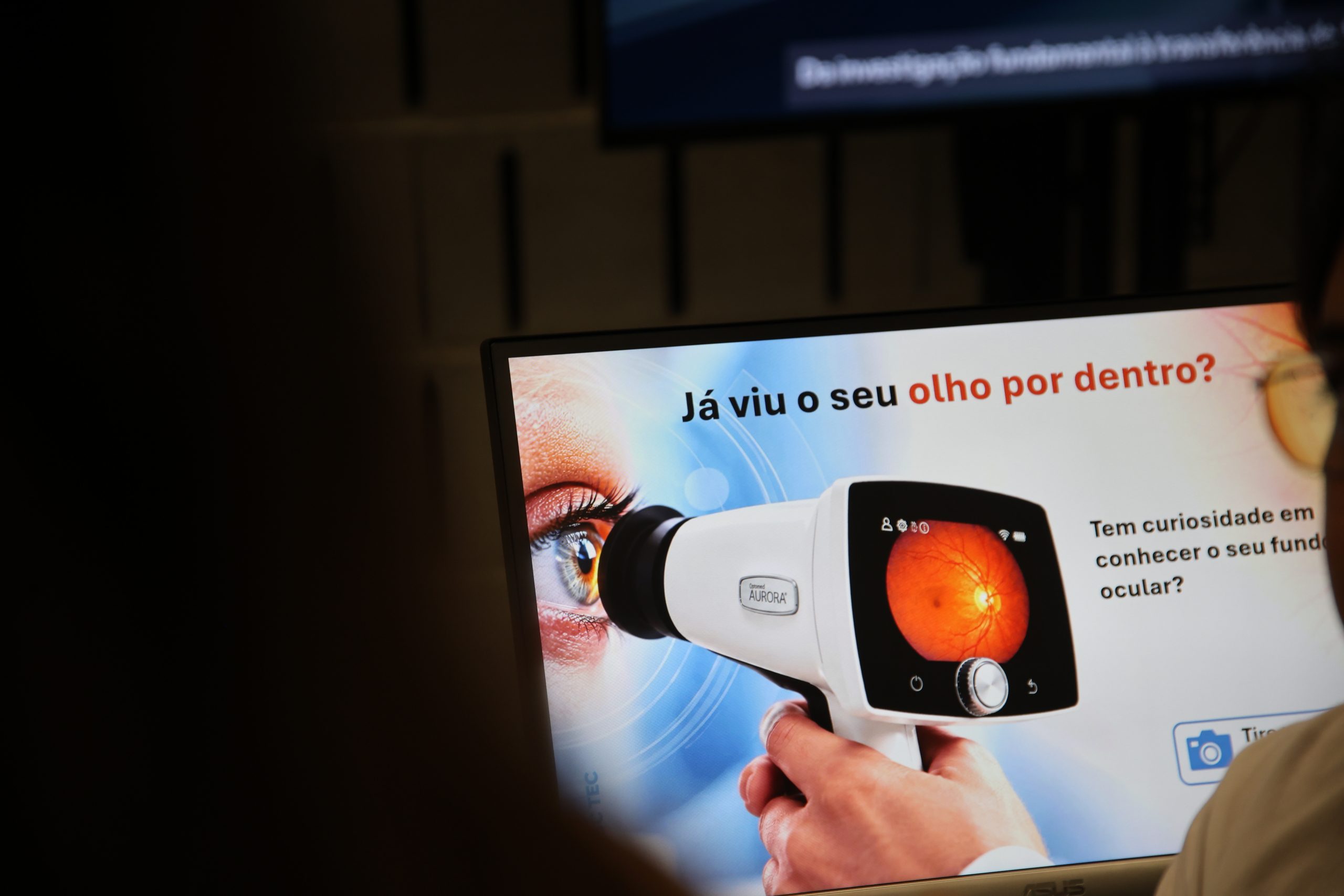
40 countries, hundreds of European cities – this is how science is celebrated every year at the end of September, during what is known as European Researchers’ Night. This year was no different, with INESC TEC taking research to the streets in three cities (Porto, Vila do Conde and Braga) to raise awareness among younger audiences of the importance of science and innovation and explain not only what researchers do, but also how the technology we develop can be used in everyday life.
In Porto, INESC TEC joined forces with i3S for the most crowded edition ever, with more than 1000 participants, through both an interactive session entitled “Ciência no feminino: visibilidade, representatividade e ação” and an exhibition of healthcare technologies. In Vila do Conde, the Institute presented a new project at Vila do Conde’s Centro Ciência Viva. In Braga, INESC TEC’s research teams working in computing, cybersecurity and databases travelled to Forum Braga.
Young people’s curiosity about Portugal’s first scientist-astronaut: “Is there life on Mars?”
“Ciência no feminino: visibilidade, representatividade e ação” was the title of two interactive sessions aimed at presenting global, European and national figures on the representation of women in science, culminating in the story of Portugal’s first scientist-astronaut: Ana Pires, INESC TEC researcher.
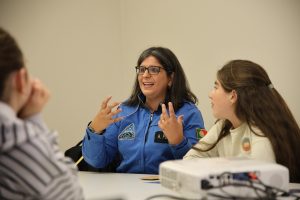
Ana Pires shared a journey that was “less obvious for someone whose main background is in geosciences”, but “the desire to learn more and explore new areas” was never held back by anyone. It is an inspiring journey, but one that also comes with sacrifices -“being away for a month to go to Utah, in the United States, comes with personal sacrifices. Having to go a week early, spend two weeks in isolation and stay for another week afterwards. But when I look back, I think that I had and still can do many things that many people do not.”
Ana inspired an audience that included not only younger girls and boys, but also their family members. She particularly inspired those who already knew exactly what they wanted to pursue – “I want to study medicine,” said a 10-year-old girl, while another 9-year-old said, “I want to be an astrobiologist and study microorganisms on the Moon or on Mars.” She inspired them by explaining that they do not have to be engineers to join, for example, NASA or the European Space Agency – “they are always looking for doctors, for example, because otherwise who would look after the astronauts’ wellbeing?”
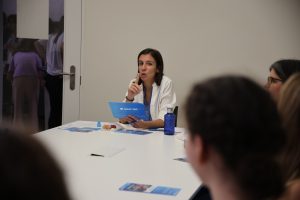
She was asked a wide range of questions, including “Do you believe there is life on Mars?” – not only by children, but by adults too. The audience’s curiosity and interest in the INESC TEC researcher’s story meant that both sessions lasted longer than planned. At the end, participants asked for photographs – girls, families and Ana Pires in her flight suit. Two sessions organised, two rooms full: mission accomplished. Whenever the sessions ended, participants were reminded that INESC TEC is about much more than robotics and that, downstairs, a group of researchers working in bioengineering had a stand where visitors could undergo retinal tests.
“Will I have vision problems in the future?”
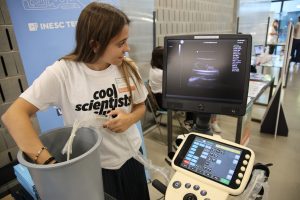
Several INESC TEC researchers working in bioengineering were on the ground floor of i3S, showcasing biomedical imaging technologies and demonstrating them to members of the audience. Children and adults alike had the opportunity to explore a fundus camera, used to obtain images of the back of the eye, as well as a whole-body tomographic imaging system that allowed participants to interact with the technology.
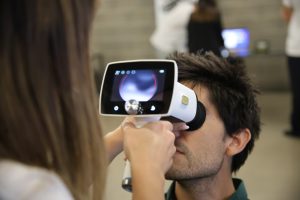
João Pedrosa, Tânia Melo, Ana Filipa Sousa, Daniel Proaño-Guevara and Nora Kovacs were the INESC TEC researchers involved in the exhibition. According to João Pedrosa, “there is something special about talking to the public, particularly when children are involved, and at i3S we had an opportunity to think about how we can better showcase our research and who we are to the public. Really important things happen when science leaves the laboratory!”
Vila do Conde: Ensuring a sustainable future for all
At Vila do Conde’s Centro Ciência Viva, INESC TEC presented the ORION project, with an interactive presentation of the Digital Twins related to several demonstrators – complemented by an exploratory guide and a set of questions that participants answered by interacting with the prototype.
Representing the project were Filipe Tadeu Oliveira, Tatiana Pereira, Celestino Silva and José Pedro Sousa, INESC TEC researchers in the field of energy. For Celestino, “participating in ERN 2026 was a good opportunity to showcase our work, exchange ideas with other people and understand the interest these topics generate among different audiences”. Tatiana added that “although the audience was mostly young, aged between 3 and 13, the event showed that it is possible to communicate discoveries and existing technologies clearly, accessibly and informatively, without compromising scientific rigour.”
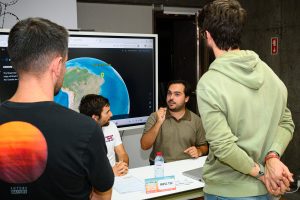
Funded by the European Union, the ORION project supports the transition towards a sustainable, resilient and cyber-secure energy system aligned with European climate targets, with the aim of achieving a carbon-neutral future by 2050.
Braga: Sparking interest in scientific careers
INESC TEC also took part in the event at Forum Braga, with a range of interactive activities that brought research and technology to the wider public. Through games and challenges, children, young people and adults were invited to discover how science is done and the impact it has on their daily lives.
In the field of cybersecurity, the Rescueware and INOCULUM projects raised awareness of the dangers of ransomware attacks and the small everyday decisions that can help prevent attacks and/or reduce the damage they cause. Younger visitors tried out the “File Guardian” game, a card game in which they had to protect their files from the Ransom monster, learning to stop, think and ask for help before acting in the digital world. Young people and adults, meanwhile, faced “Locked Out”, a digital game based on decisions and their consequences, applied to scenarios involving emails, invoices and other digital content.
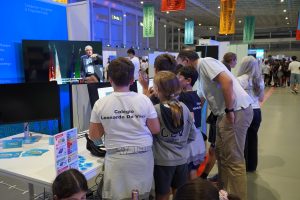
“Both the Rescueware and INOCULUM projects include dissemination and awareness-raising activities focused on this type of attack and protection techniques. Through different games and activities, we were able to promote several cyber-security practices around this issue, which increasingly affects personal computers and critical infrastructures, such as healthcare,” explained João Paulo, an INESC TEC researcher in distributed systems and lecturer at the School of Engineering of the University of Minho.
Interoperability, or the ability of systems and data from different sources to communicate with one another, was another topic explored. Through the “The Language of Computers” game, younger visitors discovered that a message can only get through when both sides know the same code. Younger and adult participants could test themselves with “Mixed-up Commands”, in which teams guided the same robot using different words and discovered that sharing words is not enough – they also need to share meanings.
“It is essential to understand how information systems manage, share and interpret data. Through this initiative, we sought to show younger audiences, in a playful way, the importance of context in the meaning of messages and the need to understand the tools of modern society and how we can prepare the society of the future,” explained Fábio Coelho, an INESC TEC researcher in distributed systems.
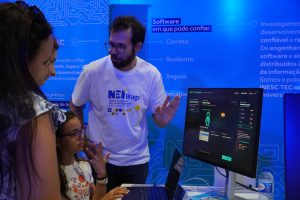
The connection with the National Advanced Computing Centre (CNCA) was made through high-performance computing and Artificial Intelligence (AI). In “Be a Supercomputer!”, each child became a processing core and helped put together a puzzle as a team, just as the Deucalion supercomputer solves huge problems using thousands of processors in parallel. The “AI or Human?” game also challenged younger visitors to guess who had created a text, image or weather forecast and reflect on model training and AI ethics. Visitors could also explore what currently runs on Deucalion, from natural disaster forecasting to drug discovery, and compare how long each task would take on a standard laptop.
“With these activities, we wanted to bring the public closer to the Deucalion supercomputer and show what lies behind the AI we use in our daily lives. Through a puzzle, a game in which participants had to distinguish between something created by AI and something created by a human, and a live demonstration of weather forecasting generated by an AI model, we sought to explain, in a playful way, that these systems depend on enormous computing capacity and that it is important to understand how they work and what their limitations are,” explained Claúdia Brito, INESC TEC researcher in high-performance computing and Artificial Intelligence.
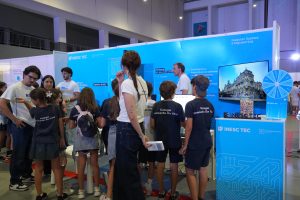
For older visitors, “Face to Face” was a memory game using real magnetic resonance imaging scans, in which the anonymisation of faces by an AI model made the pairs harder to identify. The activity provided a practical demonstration of what it means to protect a patient’s identity and how this makes it possible to gather more data to train models that help detect tumours.
“With a memory game, we also sought to introduce the possibility of transforming sensitive data into private data, while further highlighting the computing capacity of the supercomputer. Through these initiatives, we also demonstrated the synergy between research carried out at INESC TEC and everyday applications, with the Deucalion team and the supercomputer itself,” added the researcher.
Finally, “Hunt for Data”, aimed at high school and college students, proposed a race through a film database, in which each correctly formulated query revealed the next clue. Along the way, participants learned about the challenges of data organisation and the work of the ADAPQO project, which aims to go beyond the state of the art represented by DuckDB.
“This activity allowed us to communicate to the public the fundamental challenge faced by a data management system when responding to queries from users and applications, which is the central objective of the ADAPQO project,” explained José Orlando Pereira, an INESC TEC researcher and lecturer at the School of Engineering of the University of Minho.
About ERN
European Researchers’ Night is an annual European science communication initiative that brings researchers and civil society together through interactive, accessible and free experiences. Created in 2005 by the European Commission as part of the Marie Skłodowska-Curie Actions, this initiative was established with a clear objective: to bring scientific research closer to people and show that science is part of everyone’s lives.
Held in dozens of European countries, the programme invites people of all ages to discover the impact of science on everyday life, promoting dialogue between research, citizens and their communities. The goal is not merely to raise awareness passively and in one direction, but to share how science can and should contribute to finding solutions to problems.
However, creating a lasting connection between science and society requires more than a single event. For this reason, MSCA-funded projects, which celebrate their 30th anniversary this year, organise activities throughout the year. In Portugal, the upcoming editions of 2026 and 2027 will be promoted through the BRIDGES project – Bridges for Science: Engaging Researchers, Schools, and Citizens for a Sustainable Future for Europe – funded by the European Commission and coordinated by ITQB NOVA in partnership with Ciência Viva – Agência Nacional para a Cultura Científica e Tecnológica – and i3S – Institute for Research and Innovation in Health.
 News, current topics, curiosities and so much more about INESC TEC and its community!
