


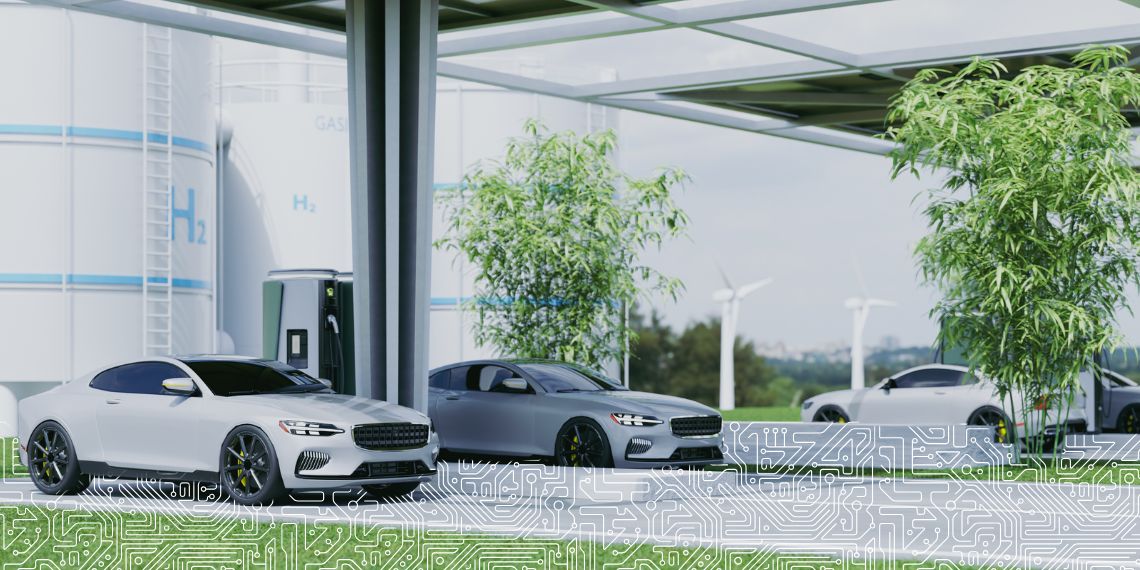
What if hydrogen were the key to sustainable mobility? Through the INERH2 project, Portugal and Spain will establish a cross-border research network dedicated to the planning, management and operation of electric vehicle charging and hydrogen refuelling infrastructures.
Despite the growth of electric mobility and increasing interest in green hydrogen, significant challenges remain, including system interoperability, insufficient infrastructure coverage, and the integration of these infrastructures with renewable energy sources.
Over the next three years, project partners will study different configurations of charging and refuelling stations, develop artificial intelligence-based forecasting and control algorithms, integrate energy storage solutions, and explore strategies such as Vehicle-to-Grid (V2G), which enables bidirectional interaction between electric vehicles and the power grid. The project will also validate the proposed solutions in real-world environments, assessing their technical and economic viability before market deployment.
“INERH2 does not look at technology in isolation, but rather at how Portugal and Spain can work together to develop a more interoperable, sustainable and intelligent network of electric mobility and hydrogen infrastructure,” explains the researcher.
INESC TEC brings extensive expertise in energy systems to the project, particularly in the areas of optimisation, smart grids, renewable energy integration and digital platforms. The institute will contribute to defining use cases, developing models for planning charging infrastructure and green hydrogen production facilities, and integrating and evaluating the tools developed throughout the project.
The goal is to create scalable solutions capable of supporting investment and operational decision-making by public authorities, infrastructure operators and technology companies. According to Filipe Joel Soares, this phase will make it possible to “test different configurations of electric charging and hydrogen refuelling infrastructures, evaluate the performance of intelligent management platforms, and assess their technical and economic feasibility”.
The project also includes “capitalisation activities, engagement with key stakeholders, and the identification of regulatory, technical and market barriers, precisely to ensure the continuity and uptake of project results beyond its completion”.
By the end of the project, the partners expect to deliver tools to support the sizing and assessment of electric vehicle charging and hydrogen refuelling stations, produce recommendations for public policies, and define strategies to facilitate the adoption of these technologies. The cross-border dimension is one of INERH2’s main strengths, fostering a coordinated approach between Portugal and Spain towards the development of a more sustainable, interoperable and decarbonisation-ready mobility network.
“The project represents an opportunity to apply knowledge developed over many years to real-world energy transition challenges, contributing to smarter, more efficient and better integrated infrastructure across the Iberian Peninsula,” adds Filipe Joel Soares.
The project is co-funded by the European Regional Development Fund (ERDF) under the Interreg Programme. In addition to INESC TEC, the consortium includes Fundación Corporación Tecnológica de Andalucía, Instituto Tecnológico de Galicia, the University of Seville, the National Institute for Aerospace Technology (INTA), the University of Algarve, AREAL – Algarve Regional Energy and Environment Agency, and Vasco da Gama CoLAB.
The project also benefits from the participation of the Regional Government of Andalusia (Junta de Andalucía), the Andalusian Hydrogen Association and Endesa X Way as associated partners.
 News, current topics, curiosities and so much more about INESC TEC and its community!
