


What if it were possible to power industrial sensors without cables or batteries, even in extreme environments? And if high-voltage power lines could be continuously monitored without electrical risk to operators? Or if sensors placed in turbines, offshore platforms, or aircraft engines no longer required frequent maintenance?
The answer may lie in the use of fibre-optic sensors and wireless energy transfer. At least, this is what INESC TEC researcher Paulo Robalinho (supervised by fellow Institute researcher Orlando Frazão) suggests in his thesis Advanced Fiber-Optic Devices for Harsh Environments Based on High-Power Wireless Energy Transfer and Novel Interferometric Architectures, which earned him the Best Thesis award granted by the Sociedade de Ótica e Fotónica.
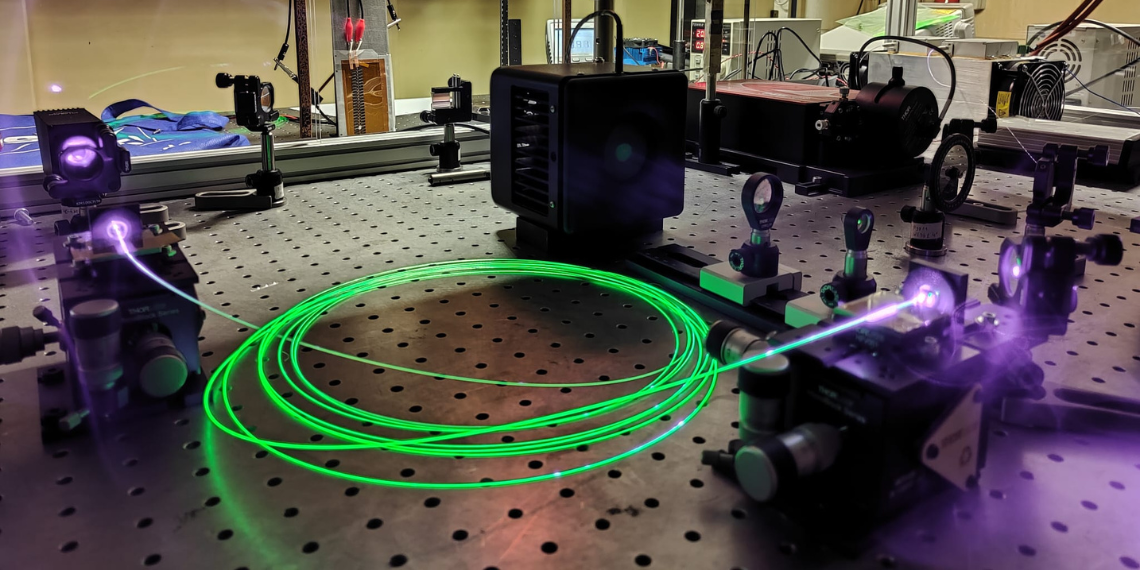
But what exactly does the awarded thesis involve? The INESC TEC researcher mentioned the development of two distinct but complementary technologies, both designed to operate under extreme conditions. “The first consists of wireless energy supply via continuous lasers in optical fibre; the second involves the development of interferometric sensing systems, including interrogators and sensors,” he explained.
The goal is the “advance of optical systems for wireless energy transmission through laser beams, aimed at enabling the powering of systems located in remote areas, as well as fibre-optic sensors based on the Vernier effect, towards increasing sensitivity.”
In practice, the innovation spans two technological areas. Concerning energy, it enables the powering of systems where installing cables is difficult or even impossible. Instead of electricity delivered through wires, energy travels as light through optical fibre, reducing weight, eliminating electrical risks, and making the process safer in environments with radiation.
In terms of sensing, the research has created fibre-optic devices capable of detecting extremely small deformations with high precision, along with an instrument that reads them 4,000 times per second – fast enough to monitor phenomena such as real-time vibrations or impacts in satellites and other extreme environments.
After completing his thesis, Paulo Robalinho moved to distributed fibre-optic sensing, using both Distributed Acoustic Sensing (DAS) and polarimetric measurements. “In addition, I continue to collaborate on the development of systems based on the Vernier effect and the WLI technique, with new publications expected in the coming months,” he concluded.
 News, current topics, curiosities and so much more about INESC TEC and its community!
