


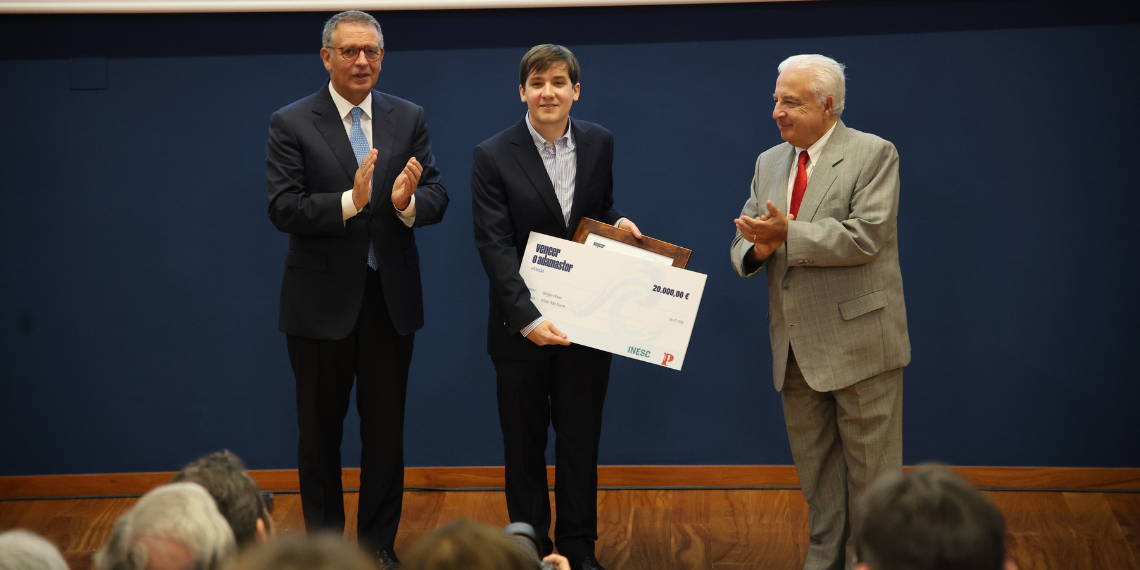
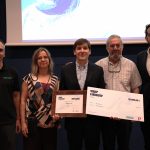
For the first time, the Vencer o Adamastor award left Lisbon to demonstrate that Adamastor can be conquered across the country and in many different fields. This year’s winner, Sérgio Jesus, received the award before a packed audience and under the applause of the President of the Republic, António José Seguro. His PhD research focused on the robust evaluation of fairness and explainability in real-world Artificial Intelligence systems, bringing to the forefront critical questions about auditing AI and ensuring that models operate fairly.
 Even before the ceremony began, Sérgio Jesus stood out. Reserved, smiling and chatting animatedly in a corner of the Ferreira da Silva Auditorium at the Faculty of Sciences of the University of Porto, the winner of the fourth edition of the award (organised by INESC and the newspaper Público) clearly shared a close rapport with two of his supervisors. João Gama and Rita Ribeiro, both researchers at INESC TEC, together with Pedro Saleiro (then at Feedzai, and now at Opnova) and Pedro Bizarro, who heads Feedzai’s Research Department, mentored Sérgio throughout a journey that Ana Cristina Freire, Dean of the Faculty of Sciences of the University of Porto, would later describe as unique. The work also benefited from the collaboration of Professor Rayid Ghani from Carnegie Mellon University.
Throughout the ceremony, speakers highlighted Sérgio’s achievement, “his dedication and hope”. Looking back on his journey, the Dean reminded the audience that “merit is never just an outcome. It is a long journey built on hard work, perseverance, difficult choices and the confidence of those who believe it is worth carrying on.”
Literary references inevitably transformed metaphors into reflections on today’s challenges and the importance of asking the right questions. “Not only technical questions,” António José Seguro observed, “but questions that have consequences for people’s lives.” After all, he added, “the political conversation AI needs to be informed by scientific knowledge.”
Sérgio’s research asked exactly those kinds of questions. “When an Artificial Intelligence system provides an explanation for a decision, does that explanation genuinely help the decision-maker, or does it simply create the appearance of accountability?” He also asked: “When an algorithm makes mistakes – as it inevitably does -, does it make the same mistakes for everyone, or does it fail differently for different groups, placing the greatest burden on those who already face the greatest disadvantages?”
Addressing the audience in Porto, the President of the Republic described these as “questions of justice, questions that strengthen democracy”. He also stressed that the fact they had been asked by “a Portuguese researcher, in the city of Porto, working alongside some of the world’s leading universities and publishing in the most demanding scientific journals in the field, tells us something about the country we are and the country we can become.”
Science as a force for change
In the age of AI, language models make decisions every second. “This field is expanding at an extraordinary pace,” said Sérgio Jesus as he thanked his supervisors from the stage. “AI is already being used in financial systems, in medical decision support and in recruitment processes.” As AI adoption grows, so does awareness of potential risks, particularly the growing number of documented cases in which systems unintentionally discriminate against certain groups.
David Pontes, editor-in-chief of Público, highlighted the ethical and responsible principles that this new technological landscape demands. “Science has both a voice and a mission,” he said. “It transforms the pursuit of knowledge into a powerful force for change.” From the front row, Sérgio Jesus listened as speaker after speaker praised the years of work behind his research.
David Pontes described the project as an effort to “raise barriers and awaken awareness of the responsible use of technologies that will become ubiquitous and shape the world in the years ahead.” Pedro Nuno Teixeira, the newly appointed Rector of the University of Porto, argued that society’s response to AI “should be guided neither by fear nor fascination, but by our ability to understand these technologies critically.”
Throughout a ceremony where scientific evidence blended naturally with broader reflections, the Rector emphasised the significance of Sérgio’s work. Demonstrating scientifically where AI systems fail – and where they produce unfair outcomes – is a way of improving them and making their deployment more responsible and more ethical.
As Helena Canhão, Portugal’s Secretary of State for Education, Science and Innovation, highlighted, “Generative artificial intelligence models and their applications are changing society.”
Sérgio illustrated the importance of his research by contrasting it with current approaches to algorithmic fairness. Most existing methods attempt to correct known biases once they have already been identified. Sérgio chose a different path: he applied the logic of software engineering stress tests to AI systems, pushing them deliberately to breaking point, with discrimination serving as the failure criterion. To achieve this, he used real-world datasets while artificially amplifying three different types of bias that commonly occur in practice. “In the first scenario, we reduced the representation of one group. For example, if the dataset initially contained equal numbers of men and women, we reduced the proportion of women to just 5%,” he explained.
The second scenario drew inspiration from Feedzai’s work on fraud detection by disproportionately increasing the fraud rate assigned to one specific group.
In the third scenario, the researchers deliberately made the model’s decision significantly more ambiguous and difficult for only one of the groups.
After testing several so-called “fair AI” methods against these scenarios, Sérgio reached an important conclusion. “None of the methods managed to solve every type of bias.” His findings suggest that developers must test AI models against multiple forms of bias if they want to expose their specific failure points. Simply applying a fairness algorithm does not, by itself, guarantee fair outcomes.
His research also explored model explainability, arguing that evaluations should focus on the real impact explanations have on people’s decisions rather than relying solely on indirect metrics.
The ceremony also looked towards the future. Arlindo Oliveira, President of INESC, reflected on the Institute’s founding vision. “The pioneering model proposed by INESC – creating private, non-profit scientific and technological institutions -overcame many of the limitations of the scientific and higher education system at the time. That model proved successful and inspired many of the institutions that now exist, thrive and have significantly strengthened Portugal’s scientific ecosystem.”
The President of the Republic returned once more to Luís de Camões. “Today’s Adamastor is not the same Adamastor we find in Os Lusíadas,” he said. “Adamastor constantly changes shape; it never disappears. It always has a different name. Today it is called opacity. It is called the black box. It is called an algorithm that makes decisions without explaining them. That is why we will always need people with the courage and precision to confront it.”
Sérgio Jesus has done exactly that. Looking ahead, he identified two major challenges: adapting these evaluation methods to much larger AI systems, such as large language models, and democratising access to robust evaluation tools. “We want everyone to be able to assess their models more thoroughly and more rigorously, reducing the risks when these systems are deployed for public use.”
As António José Seguro concluded, society still does not always recognise the excellence of the research carried out in Portugal. “A society that does not know the people’s own capabilities cannot make informed choices about the future.”
He closed the ceremony by returning to the spirit of Adamastor. “The ‘Vencer o Adamastor’ Award exists to correct that invisibility. It exists to say, loudly and clearly, that Portuguese researchers are working at the frontier of the most important questions of our time. We do not need to look abroad for what we already have at home. Portuguese science is not only capable of competing with the world – it is capable of leading the questions the world has not yet learned to ask.”
The award jury was chaired by José Tribolet, founder of INESC, and included several members of INESC TEC, namely João Peças Lopes, José Carlos Marques dos Santos and Pedro Guedes de Oliveira.

 News, current topics, curiosities and so much more about INESC TEC and its community!
